Advertisements
Advertisements
प्रश्न
Differentiate convex lens and concave lens.
Advertisements
उत्तर
| Convex Lens | Concave Lens |
| 1. The lens which is thicker at the centre than at the edges. | 1. The lens is thinner at the centre than at the edges. |
| 2. Abeam of light passing through it, is converged to a point. | 2. A beam of light passing through it is diverged or spread out. |
| 3. It is called a converging lens. | 3. It is called a diverging lens. |
APPEARS IN
संबंधित प्रश्न
To determine the approximate focal length of the given convex lens by focussing a distant object (say, a sign board), you try to focus the image of the object on a screen. The image you obtain on the screen is always
(a) erect and laterally inverted
(b) erect and diminished
(c) inverted and diminished
(d) virtual, inverted and diminished
One-half of a convex lens is covered with a black paper. Will this lens produce a complete image of the object? Verify your answer experimentally. Explain your observations.
A convex lens of focal length 8 cm forms a real image of the same size as the object. The distance between object and its image will be:
Calculate the focal length of a convex lens which produces a virtual image at a distance of 50 cm of an object placed 20 cm in front of it.
A convex lens of focal length 6 cm is held 4 cm from a newspaper which has print 0.5 cm high. By calculation, determine the size and nature of the image produced.
A convex lens is placed in water. Its focal length will ______.
In the following cases, where must an object be placed in front of a convex lens so that the image formed is at infinity?
In the following cases, where must an object be placed in front of a convex lens so that the image formed is of the same size as the object?
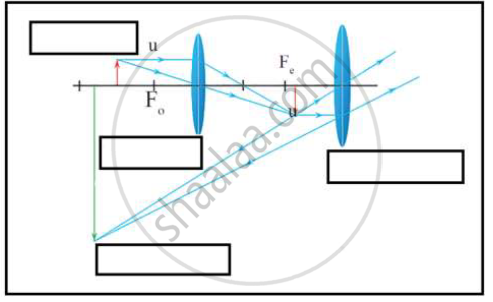
i. Which type of microscope has the arrangement of lenses shown in the adjoining figure?
ii. Label the figure correctly.
iii. Write the working of this microscope.
iv. Where does this microscope used?
v. Suggest a way to increase the efficiency of this microscope.
Distinguish between:
Concave lens and Convex lens
