Advertisements
Advertisements
प्रश्न
Differentiate convex lens and concave lens.
Advertisements
उत्तर
| Convex Lens | Concave Lens |
| 1. The lens which is thicker at the centre than at the edges. | 1. The lens is thinner at the centre than at the edges. |
| 2. Abeam of light passing through it, is converged to a point. | 2. A beam of light passing through it is diverged or spread out. |
| 3. It is called a converging lens. | 3. It is called a diverging lens. |
APPEARS IN
संबंधित प्रश्न
An object 5 cm in length is held 25 cm away from a converging lens of focal length 10 cm. Draw the ray diagram and find the position, size and the nature of the image formed.
When a ray of light enters from one medium to another having different optical densities it bends. Why does this phenomenon occur?
You eye contains a convex lens. Why is it unwise to look at the sun?
A convex lens of focal length 6 cm is held 4 cm from a newspaper which has print 0.5 cm high. By calculation, determine the size and nature of the image produced.
An object 50 cm tall is placed on the principal axis of a convex lens. Its 20 cm tall image is formed on the screen placed at a distance of 10 cm from the lens. Calculate the focal length of the lens.
What kind of lens can form:
an erect magnified image?
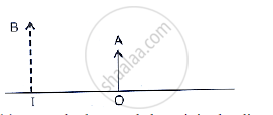
The given below figure shows an object OA and its image IB formed by a lens.
A pin 2 cm long is placed 12 cm away from a convex lens at right angles to the principal axis. If the focal length of the lens is 20 cm, by scale drawing find the size of the image and its magnification.
For a specific glass lens f = 0.5 m. This is the only information given to the student. Which type of lens is given to him and what is its power?
