Advertisements
Advertisements
प्रश्न
Differentiate the eye defects: Myopia and Hypermetropia
Advertisements
उत्तर
| Myopia | Hypermetropia |
| Myopia, also known as short-sightedness, occurs due to the lengthening of the eyeball. | Hypermetropia, also known as long-sightedness, occurs due to the shortening of the eyeball. |
| With this defect, nearby objects can be seen clearly but distant objects cannot be seen clearly. | With this defect, distant objects can be seen clearly but nearby objects cannot be seen clearly. |
| The focal length of the eye lens is reduced or the distance between the eye lens and retina increases. | The focal length of the eye lens is increased or the distance between the eye lens and retina decreases. |
| The far point will not be infinity for such eyes and the far point has come closer. | Hence, the near point will not be at 25 cm for such eyes and the near point has moved farther. |
| Due to this, the image of distant objects is formed before the retina. | Due to this, the image of nearby objects is formed behind the retina. |
| This defect can be corrected using a concave lens | This defect can be corrected using a convex lens. |
APPEARS IN
संबंधित प्रश्न
Given below is a diagram showing a defect of human eye. Study it and answer the following questions.

(i) Name the defect shown in the figure.
(ii) Give reason for this defect of eye in human being.
(iii) Name the type of lens used to correct the eye defect.
Name an old age eye defect. What happens in it?
A person cannot read newspaper placed nearer than 50 cm from his eyes. Name the defect of vision he is suffering from. Draw a ray diagram to illustrate this defect. List its two possible causes. Draw a ray diagram to show how this defect may be corrected using a lens of appropriate focal length.
Write whether the following is true or false:
A convex lens is used for correcting myopia.
Give Reason:
Older people require glasses to read and write.
Explain the Term: Astigmatism
Observe the given below the figure, correct it and explain and write about the concept depicted in this figure.
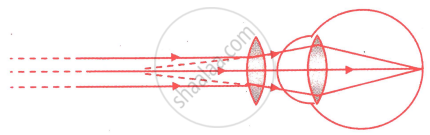
Given below is a diagram showing a defect of vision. Name the defect of vision and draw an accurately labelled diagram to correct this defect.
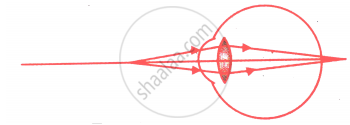
Draw ray diagram showing myopic eye.
A person needs a lens of power –4.5 D for correction of her vision.
- What kind of defect in vision is she suffering from?
- What is the focal length of the corrective lens?
- What is the nature of the corrective lens?
