Advertisements
Advertisements
प्रश्न
What are the two most common defects of vision (or defects of eye)? How are they corrected?
Advertisements
उत्तर
The two most common defects of vision (or defects of the eye) are the following.
1. Myopia (short-sightedness or near-sightedness): Myopia is an eye defect because of which a person cannot see faraway objects clearly but can see nearby objects normally. By using spectacles with concave lenses, myopia can be corrected, as a concave lens reduces the converging power of the eye lens and therefore forms the images of faraway objects on the retina of the myopic eye.
2. Hypermetropia (long-sightedness or far-sightedness): Hypermetropia is an eye defect because of which a person cannot see nearby objects clearly but can see faraway objects normally. By using spectacles with convex lenses, hypermetropia can be corrected, as a convex lens increases the converging power of the eye lens and therefore forms the images of nearby objects on the retina of the hypermetropic eye.
The two most common defects of vision (or defects of the eye) are the following.
1. Myopia (short-sightedness or near-sightedness): Myopia is an eye defect because of which a person cannot see faraway objects clearly but can see nearby objects normally. By using spectacles with concave lenses, myopia can be corrected, as a concave lens reduces the converging power of the eye lens and therefore forms the images of faraway objects on the retina of the myopic eye.
2. Hypermetropia (long-sightedness or far-sightedness): Hypermetropia is an eye defect because of which a person cannot see nearby objects clearly but can see faraway objects normally. By using spectacles with convex lenses, hypermetropia can be corrected, as a convex lens increases the converging power of the eye lens and therefore forms the images of nearby objects on the retina of the hypermetropic eye.
The two most common defects of vision (or defects of the eye) are the following.
1. Myopia (short-sightedness or near-sightedness): Myopia is an eye defect because of which a person cannot see faraway objects clearly but can see nearby objects normally. By using spectacles with concave lenses, myopia can be corrected, as a concave lens reduces the converging power of the eye lens and therefore forms the images of faraway objects on the retina of the myopic eye.
2. Hypermetropia (long-sightedness or far-sightedness): Hypermetropia is an eye defect because of which a person cannot see nearby objects clearly but can see faraway objects normally. By using spectacles with convex lenses, hypermetropia can be corrected, as a convex lens increases the converging power of the eye lens and therefore forms the images of nearby objects on the retina of the hypermetropic eye.v
APPEARS IN
संबंधित प्रश्न
What is myopia?
A student is unable to see clearly the words written on the blackboard placed at a distance of approximately 4 m from him. Name the defect of vision the boy is suffering from. Explain the method of correcting this defect.
Draw ray diagram for the:-
(i) defect of vision and also
(ii) for its correction.
List three common refractive defects of vision. Suggest the way of correcting these defects.
The far point of a myopic person is 80 cm in front of the eye. What is the nature and power of the lens required to correct the problem?
Name the defect of vision in a person:
whose far point is less than infinity
Which defect of vision can be rectified:
by using a concave lens?
A man can read the number of a distant bus clearly but he finds difficulty in reading a book.
- From which defect of the eye is he suffering?
- What type of spectacle lens should he use to correct the defect?
A student sitting in the last row of the class-room is not able to read clearly the writing on the blackboard.
- Name the type of defect he is suffering from.
- How can this defect by corrected?
Though a woman can see the distant object clearly, she cannot see the nearby objects clearly. She is suffering from the defect of vision called:
(a) long-sight
(b) short-sight
(c) hind-sight
(d) mid-sight
Differentiate between members of the following pair with reference to what is asked in bracket.
Myopia and hyperopia (cause of the defect)
Differentiate between members of the following pair with reference to what is asked in the bracket.
Rods and cones (sensitivity).
Have a look at the posture of this girl who is reading a book and answer the questions which follow:

Name the problem she is facing.
Draw a ray diagram to show how Hypermetropia is defect can be corrected using a lens.
When do we consider a student sitting in the class to be myopic? List two causes of this defect. Explain using a ray diagram how this defect of eye can be corrected.
Given below is a diagram depicting a defect of the human eye? Study the same and answer the question that follow:
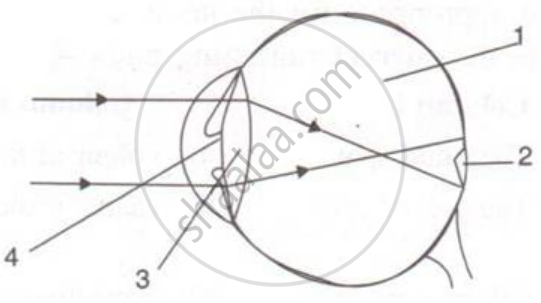
Give two possible reasons for this defect of the eye in human beings.
Differentiate between:
Myopia and Hypermetropia.
Name the following:
The defect of the human eye caused due to the uneven surface of the cornea.
Write scientific reason.
Nearsightedness, this defect can be corrected by using spectacles with concave lens.
What are the causes of ‘Myopia’?
Observe the figure and answer the following questions:

- Name the defect of vision represented in the above figure.
- State the reasons for this defect.
- How is it corrected?
- Draw the diagram to show the correction of this defect.
