Advertisements
Advertisements
Question
A student suffering from myopia is not able to see distinctly the objects placed beyond 5 m. List two possible reasons due to which this defect of vision may have arisen. With the help of ray diagrams, explain
(i) why the student is unable to see distinctly the objects placed beyond 5 m from his eyes.
(ii) the type of the corrective lens used to restore proper vision and how this defect is corrected by the use of this lens.
(b) If, in this case, the numerical value of the focal length of the corrective lens is 5 m, find the power of the lens as per the new Cartesian sign convention
Advertisements
Solution
Two possible reasons due to which this defect of vision may have arisen are
(a) increase in curvature of the lens
(b) increase in length of the eyeball
(i) A myopic eye has its far point nearer than infinity. It forms the image of a distant object in front of its retina as shown in the figure given below. In the given case student's far point is 5 m. So, image of the object placed beyond 5 m from his eyes is formed in front of the retina and hence appears blurred. That is why the student is unable to see distinctly the objects placed beyond 5 m from his eyes.

(ii) Since a concave lens has an ability to diverge incoming rays, it is used to correct this defect of vision. The image is allowed to form at the retina by using a concave lens of suitable power as shown in the given figure.
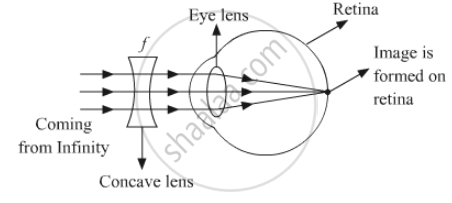
(b) Power of the required corrective lens (P) =`1/(f("in m"))`
`P =− 1/5 `
`P= −0.2 D`
Hence, the power of corrective lens is -0.2 D.
APPEARS IN
RELATED QUESTIONS
The defect of vision in which the eye-lens of a person gets progressively cloudy resulting in blurred vision is called:
(a) myopia
(b) presbyopia
(c) colourblindness
(d) cataract
To read a book held at a distance of 25 cm, will she need converging or diverging spectacle lenses?
The near point of the eye of a person is 50 cm. Find the nature and power of the corrective lens required by the person to enable him to see clearly the objects placed at 25 cm from the eye?
Give Reason:
When you enter into a dark room from bright because of sunlight, you can not see things for a few seconds.
Differentiate between:
Short-sightedness and Long-sightedness.
Explain the Term: Presbyopia
The diagram given below represents the cross-section of the human eye:

(i) Name the parts labeled 1—12.
(ii) What is the function of the part marked ‘10’?
(iii) What would happen if part ‘5’ is damaged or cut?
Nearsightedness : concave lens : : farsightedness : _______
Assertion: Concave mirrors are used as reflectors in torches, vehicle head lights and in search lights.
Reason: When an object is placed beyond the center of curvature of a concave mirror, the image formed is real and inverted.
Draw ray diagram showing myopic eye.
