Advertisements
Advertisements
प्रश्न
A student suffering from myopia is not able to see distinctly the objects placed beyond 5 m. List two possible reasons due to which this defect of vision may have arisen. With the help of ray diagrams, explain
(i) why the student is unable to see distinctly the objects placed beyond 5 m from his eyes.
(ii) the type of the corrective lens used to restore proper vision and how this defect is corrected by the use of this lens.
(b) If, in this case, the numerical value of the focal length of the corrective lens is 5 m, find the power of the lens as per the new Cartesian sign convention
Advertisements
उत्तर
Two possible reasons due to which this defect of vision may have arisen are
(a) increase in curvature of the lens
(b) increase in length of the eyeball
(i) A myopic eye has its far point nearer than infinity. It forms the image of a distant object in front of its retina as shown in the figure given below. In the given case student's far point is 5 m. So, image of the object placed beyond 5 m from his eyes is formed in front of the retina and hence appears blurred. That is why the student is unable to see distinctly the objects placed beyond 5 m from his eyes.

(ii) Since a concave lens has an ability to diverge incoming rays, it is used to correct this defect of vision. The image is allowed to form at the retina by using a concave lens of suitable power as shown in the given figure.
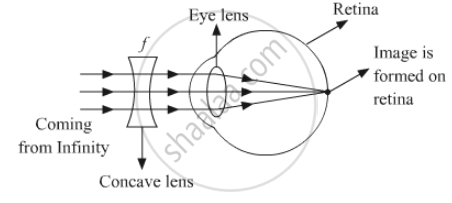
(b) Power of the required corrective lens (P) =`1/(f("in m"))`
`P =− 1/5 `
`P= −0.2 D`
Hence, the power of corrective lens is -0.2 D.
APPEARS IN
संबंधित प्रश्न
A student is unable to see clearly the words written on the blackboard placed at a distance of approximately 4 m from him. Name the defect of vision the boy is suffering from. Explain the method of correcting this defect.
Draw ray diagram for the:-
(i) defect of vision and also
(ii) for its correction.
Name the defect of vision in a person:
whose near point is more than 25 on away.
What are the two most common defects of vision (or defects of eye)? How are they corrected?
A person suffering from the eye-defect myopia (short-sightedness) can see clearly only up to a distance of 2 metres. What is the nature and power of lens required to rectify this defect?
What is meant by optical illusion? Give one example.
The near point of the eye of a person is 50 cm. Find the nature and power of the corrective lens required by the person to enable him to see clearly the objects placed at 25 cm from the eye?
The near point of the eye of a person is 50 cm. Find the nature and power of the corrective lens required by the person to enable him to see clearly the objects placed at 25 cm from the eye?
What type of lens is used to correct Astigmatism?
Draw ray diagram showing myopic eye.
Match the following:
| Column - I | Column - II |
| 1. Retina | a. Path way of light |
| 2. Pupil | b. Far point comes closer |
| 3. Ciliary muscles | c. near point moves away |
| 4. Myopia | d. Screen of the eye |
| 5. Hypermetropia | e. Power of accommodation |
