Advertisements
Advertisements
प्रश्न
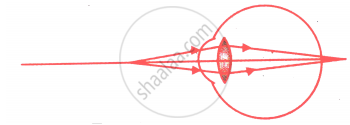
Draw a ray diagram to show how Hypermetropia is defect can be corrected using a lens.
Advertisements
उत्तर
Corrected vision for a hypermetropic eye by using a convex lens:
APPEARS IN
संबंधित प्रश्न
About 45 lac people in the developing countries are suffering from corneal blindness. About 30 lac children below the age of 12 years suffering from this defect can be cured by replacing the defective cornea with the cornea of a donated eye. How and why can students of your age involve themselves to create awareness about this fact among people?
The far point of a myopic person is 80 cm in front of the eye. What is the nature and power of the lens required to correct the problem?
Name the following:
The eye defect caused due to shortening of the eye ball from front to back.
What is meant by optical illusion? Give one example.
When do we consider a student sitting in the class to be myopic? List two causes of this defect. Explain using a ray diagram how this defect of eye can be corrected.
Mention, if the following statement is True or False
Hypermetropia is a defect of the eye caused due to the eyeball elongation
Given below is a diagram showing a defect of vision. Name the defect of vision and draw an accurately labelled diagram to correct this defect.
When do we consider a person to be myopic or hypermetropic? Explain using diagrams how the defects associated with myopic and hypermetropic eye can be corrected?
Observe the figure whether it is correct or not and explain the phenomenon.

Name the following:
Two kinds of accomodations.
