Advertisements
Advertisements
प्रश्न
Yesh find out F1 and F2 of symmetric convex lens experimentally then which conclusion is true.
विकल्प
a) 𝐹1 = 𝐹2
b) 𝐹1 > 𝐹2
c) 𝐹1 < 𝐹2
d) 𝐹1 ≠ 𝐹2
Advertisements
उत्तर
a) 𝐹1 = 𝐹2
APPEARS IN
संबंधित प्रश्न
A student wants to project the image of a candle flame on the walls of school laboratory by using a lens:-
(a) Which type of lens should be use and why?
(b) At what distance in terms of focal length 'F' of the lens should be place the candle flame so as to get (i) a magnified, and (ii) a diminished image respectively on the wall?
(c) Draw ray diagram to show the formation of the image in each case?
If you focus the image of a distant object, whose shape is given below, on a screen using a convex lens, the shape of the image of this object on the screen would be:
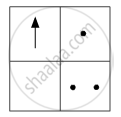
(a)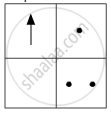
(b)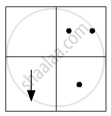
(c)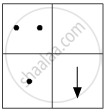
(d)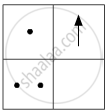
Draw a ray diagram to show the formation of the image of an object be placed so that a real and inverted image of the same size as the object is obtained using a convex lens
A ray of light travelling in water emerges into air. Draw a ray-diagram indicating the change in its path.
Draw a labelled ray diagram to show how a ray of light is refracted when it passes:
from an optically denser medium into air.
How could you find the focal length of a convex lens rapidly but approximately?
Find the position and nature of the image of an object 5 cm high and 10 cm in front of a convex lens of focal length 6 cm.
A convex lens of focal length 6 cm is held 4 cm from a newspaper which has print 0.5 cm high. By calculation, determine the size and nature of the image produced.
A beam of parallel light rays is incident through the holes on one side of a box and emerges out through the holes on its opposite side as shown in the diagram below:
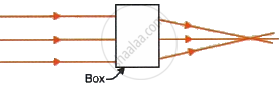
Which of the following could be inside the box?
Study the diagram given below.

- Name the lens LL’.
- What are the points O and O’ called?
- Complete the diagram to form the image of the object AB.
- State the three characteristics of the image.
- Name a device in which this action of lens is used.
When you focus the image of a distant flag, whose shape is given below, on a screen using a convex lens, the shape of the image as it appears on the screen is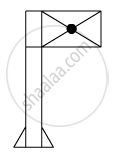
(A)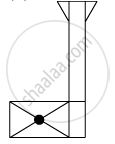
(B)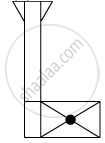
(C)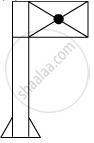
(D)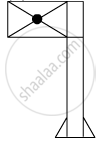
A student focussed the image of a distant object using a device ‘X’ on a white screen ‘S’ as shown in the figure. If the distance of the screen from the device is 40 cm, select the correct statement about the device.
(A) The device X is a convex lens of focal length 20 cm.
(B) The device X is a concave mirror of focal length 40 cm.
(C) The device X is a convex mirror of radius of curvature 40 cm.
(D) The device X is a convex lens of focal length 40 cm.
Draw neat diagram to show the
Convergent action of a convex lens,
State the position of object, position of image, nature of image when: Convex lens is used as objective lens of photographic camera.
State the position of object, position of image, nature of image when: Convex lens is used as in searchlight.
Can a normal convex lens behave like a concave lens and vice-versa?
Define the terms principal foci and focal lengths as applied to a convex lens, and show them with the help of proper diagrams.
Find the odd one out and give its explanation.
A convex lens of focal length 20 cm can produce a magnified virtual as well as real image. Is this a correct statement? If yes, where shall the object be placed in each case for obtaining these images?
Distinguish between:
Concave lens and Convex Lens
