Advertisements
Advertisements
प्रश्न
Observe the following figure and answer the questions.

a) Which optical instrument shows arrangement of lenses as shown in the figure?
b) Write in brief the working of this optical instrument.
c) How can we get different magnifications in this optical instrument?
d) Draw the figure again and labelled it properly
Advertisements
उत्तर
a) Arrangement of lenses shown in the figure is refracting telescope.
b) 1) object lens collect the light coming form the distant object and forms the image
2)The image works as object for the eye piece which forms the final image.
c) We can get different magnifications by using the eye piece with different focal lengths.
d)
APPEARS IN
संबंधित प्रश्न
"A convex lens can form a magnified erect as well as magnified inverted image of an object placed in front of it." Draw ray diagram to justify this statement stating the position of the object with respect to the lens in each case.
An object 5 cm is placed at a distance of 20 cm in front of a convex mirror of radius of curvature 30 cm. Find the position, nature and size of the image.
An object is placed at a distance of 15 cm from a convex lens of focal length 20 cm. List four characteristics (nature, position, etc.) of the image formed by the lens.
The diagram given alongside shows a ray of light entering a rectangular block of glass.
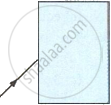
- Copy the diagram and draw the normal at the point of entry.
- Draw the approximate path of the ray of light through the glass block and out of the other side.
You eye contains a convex lens. Why is it unwise to look at the sun?
A convex lens of focal length 8 cm forms a real image of the same size as the object. The distance between object and its image will be:
If the object is moved to a point only 3 cm away from the lens, what is the new position, height and nature of the image?
What type of images can a convex lens make?
A beam of parallel light rays is incident through the holes on one side of a box and emerges out through the holes on its opposite side as shown in the diagram below:
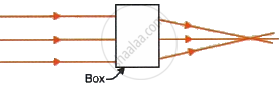
Which of the following could be inside the box?
A converging lens forms the image of an object placed in front of it, beyond 2F2 of the lens. Draw a ray diagram to show the formation of the image.
The given below figure shows an object OA and its image IB formed by a lens
. 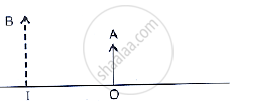
draw suitable rays to locate the lens and its focus.
When you focus the image of a distant flag, whose shape is given below, on a screen using a convex lens, the shape of the image as it appears on the screen is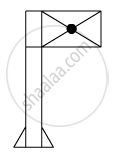
(A)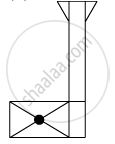
(B)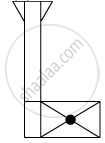
(C)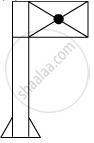
(D)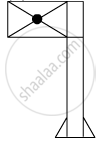
While determining the focal length of a convex lens, you try to focus the image of a distant object formed by the lens on the screen. The image formed on the screen, as compared to the object, should be
(A) erect and highly diminished
(B) erect and enlarged
(C) inverted and enlarged
(D) inverted and highly diminished
Where should an object be placed in front of a convex lens to get a real image of the size of the object?
In sunglasses, both of its surfaces are curved, yet their behaviour is neither like a convex lens nor like a concave lens. State the reason.
A candle is placed between f and 2f a convex lens. Draw a ray diagram showing the position of the image.
How will you determine the focal length of a convex lens by the plane mirror method?
Write the name.
The lens used in simple microscope.
Write scientific reason.
Adults need bifocal lens spectacle.
A beam of light is incident through the holes on side A and emerges out of the holes on the other face of the box as show in the figure. Which of the following could be inside the box?

