Advertisements
Advertisements
प्रश्न
Complete the following table:
| Instrument | Number of Convex Lenses |
Use |
| Simple Microscope | .............. | .............. |
| Compound Microscope | .............. | .............. |
| Telescope | .............. | .............. |
Advertisements
उत्तर
| Instrument | Number of Convex Lenses |
Use |
| Simple Microscope | 1 | Used by watch repairers to view tiny watch parts |
| Compound Microscope | 2 | Used by watch repairers to view tiny watch parts |
| Telescope | 2 | Used to view faraway objects in outer space |
APPEARS IN
संबंधित प्रश्न
If you focus the image of a distant object, whose shape is given below, on a screen using a convex lens, the shape of the image of this object on the screen would be:
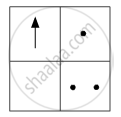
(a)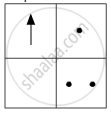
(b)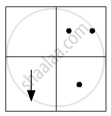
(c)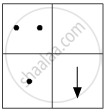
(d)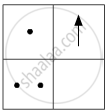
Analyse the following observation table showing variation of image-distance (v) with object-distance (u) in case of a convex lens and answer the questions that follow without doing any calculations :
| S. No. | Object-Distance u (cm) |
Image-Distance v (cm) |
| 1 | –100 | +25 |
| 2 | –60 | +30 |
| 3 | –40 | +40 |
| 4 | –30 | +60 |
| 5 | –25 | +100 |
| 6 | –15 | +120 |
(a) What is the focal length of the convex lens? Give reason to justify your answer.
(b) Write the serial number of the observation which is not correct. On what basis have you arrived at this conclusion?
(c) Select an appropriate scale and draw a ray diagram for the observation at S.No. 2. Also find the approximate value of magnification.
An object is placed at a distance of 15 cm from a convex lens of focal length 20 cm. List four characteristics (nature, position, etc.) of the image formed by the lens.
An object of height 4.0 cm is placed at a distance of 30 cm from the optical centre 'O' of a convex lens of focal length 20 cm. Draw a ray diagram to find the position and size of the image formed. Mark optical centre 'O' and principal focus 'F' on the diagram. Also find the approximate ratio of size of the image to the size of the object.
A ray of light travelling in air is incident on a parallel-sided glass slab (or rectangular glass slab). Draw a ray-diagram indicating the change in its path in glass.
The diagram given alongside shows a ray of light entering a rectangular block of glass.
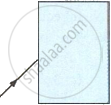
- Copy the diagram and draw the normal at the point of entry.
- Draw the approximate path of the ray of light through the glass block and out of the other side.
Draw a labelled ray diagram to show how a ray of light passes through a parallel-sided glass block if it hits the glass block at 90° (that is, perpendicular to the glass block).
A 1 cm high object is placed at a distance of 2f from a convex lens. What is the height of the image formed?
List some things that convex lens and concave mirror have in common.
Find the position and nature of the image of an object 5 cm high and 10 cm in front of a convex lens of focal length 6 cm.
Find the nature, position and magnification of the images formed by a convex lens of focal length 0.20 m if the object is placed at a distance of:
0.15 m
A student did an experiment with a convex lens. He put an object at different distances 25 cm, 30 cm, 40 cm, 60 cm and 120 cm from the lens. In each case he measured the distance of the image from the lens. His results were 100 cm, 24 cm, 60 cm, 30 cm and 40 cm, respectively. Unfortunately his results are written in wrong order.
What would be the image distance if the object distance was 90 cm?
The focal length of a thin convex lens is ______ than that of a thick convex lens.
A teacher sets up the stand carrying a convex lens of focal length 15 cm at 42.7 cm mark on the optical bench. He asks four students A, B, C and D to suggest the position of screen on the optical bench so that a distinct image of a distant tree is obtained almost immediately on it. The positions suggested by the students were as
A. 12.7 cm
B. 29.7 cm
C. 57.7 cm
D. 72.7 cm
The correct position of the screen was suggested by
(a) A
(b) B
(c) C
(d) D
A student focussed the image of a distant object using a device ‘X’ on a white screen ‘S’ as shown in the figure. If the distance of the screen from the device is 40 cm, select the correct statement about the device.
(A) The device X is a convex lens of focal length 20 cm.
(B) The device X is a concave mirror of focal length 40 cm.
(C) The device X is a convex mirror of radius of curvature 40 cm.
(D) The device X is a convex lens of focal length 40 cm.
For which position of the object does a convex lens form a virtual and erect image? Explain with the help of a ray diagram.
Where should an object be placed in front of a convex lens so as to form an inverted and enlarged image? Will the image be real or virtual? Draw a ray diagram to illustrate your answer.
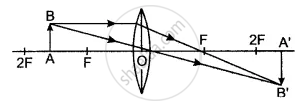
_______ times larger images can be obtained by using a simple microscope.
