Advertisements
Advertisements
प्रश्न
Complete the following table:
| Instrument | Number of Convex Lenses |
Use |
| Simple Microscope | .............. | .............. |
| Compound Microscope | .............. | .............. |
| Telescope | .............. | .............. |
Advertisements
उत्तर
| Instrument | Number of Convex Lenses |
Use |
| Simple Microscope | 1 | Used by watch repairers to view tiny watch parts |
| Compound Microscope | 2 | Used by watch repairers to view tiny watch parts |
| Telescope | 2 | Used to view faraway objects in outer space |
APPEARS IN
संबंधित प्रश्न
(a) Draw a ray diagram to show the formation of image by a concave lens when an object is placed in front of it.
(b) In the above diagram mark the object distance (u) and the image distance (v) with their proper signs (+ve or –ve as per the new Cartesian sign convention) and state how these distances are related to the focal length (f) of the concave lens in the case.
(c) Find the nature and power of a lens which forms a real and inverted image of magnification –1 at a distance of 40 cm from the optical centre.
A beam of light travelling in a rectangular glass slab emerges into air. Draw a ray-diagram indicating the change in its path.
Draw a labelled ray diagram to show how a ray of light is refracted when it passes:
from air into an optically denser medium.
A 1 cm high object is placed at a distance of 2f from a convex lens. What is the height of the image formed?
Define the principal axis of a convex lens.
You eye contains a convex lens. Why is it unwise to look at the sun?
With the help of a labelled diagram explain how a convex lens converges a beam of parallel light rays. Mark the principal axis, optical centre, principal focus and focal length of the convex lens on the diagram.
Three convex lenses are available having focal lengths of 4 cm, 40 cm and 4 m respectively. Which one would you choose as a magnifying glass and why?
Describe the nature of image formed when an object is placed at a distance of 30 cm from a convex lens of focal length 15 cm.
Find the nature, position and magnification of the images formed by a convex lens of focal length 0.20 m if the object is placed at a distance of:
0.15 m
A convex lens of focal length 15 cm produces a magnification of +4. The object is placed:
(a) at a distance of 15 cm
(b) between 15 cm and 30 cm
(c) at less than 15 cm
(d) beyond 30 cm
Which part causes the greatest convergence?
What type of lens is used to correct
hypermetropia
A lens forms an erect, magnified, and virtual image of an object.
- Name the type of lens.
- Draw a ray diagram to show the formation of the image.
- Where is the object placed in relation to the lens?
- Name the device which uses this principle.
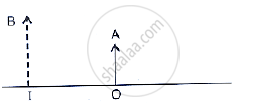
The given below figure shows an object OA and its image IB formed by a lens. State three characteristics of the image.
For finding the focal length of a convex lens by obtaining the image of a distant object, one should use as the object.
(1) a well lit distant tree
(2) window grill in the class room
(3) any distant tree
(4) a lighted candle kept at the other end of the table.
State the nature and position of the object on the principal axis to obtain a virtual and magnified image.
