Advertisements
Advertisements
प्रश्न
_______ is a combination of two convex lenses with small focal length.
पर्याय
simple microscope
compound microscope
telescope
none of these
Advertisements
उत्तर
Compound microscope is a combination of two convex lenses with small focal length.
APPEARS IN
संबंधित प्रश्न
The diagram given alongside shows a ray of light entering a rectangular block of glass.
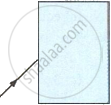
- Copy the diagram and draw the normal at the point of entry.
- Draw the approximate path of the ray of light through the glass block and out of the other side.
State any two uses of convex lenses.
Explain with the help of a diagram, why the convex lens is also called a converging lens.
An object is placed at a distance equal to 2f in front of a convex lens. Draw a labelled ray diagram to show the formation of image. State two characteristics of the image formed.
Three convex lenses are available having focal lengths of 4 cm, 40 cm and 4 m respectively. Which one would you choose as a magnifying glass and why?
Name one simple optical instrument in which the above arrangement of convex lens is used.
An object 4 cm high is placed at a distance of 10 cm from a convex lens of focal length 20 cm. Find the position, nature and size of the image.
Calculate the focal length of a convex lens which produces a virtual image at a distance of 50 cm of an object placed 20 cm in front of it.
A student did an experiment with a convex lens. He put an object at different distances 25 cm, 30 cm, 40 cm, 60 cm and 120 cm from the lens. In each case he measured the distance of the image from the lens. His results were 100 cm, 24 cm, 60 cm, 30 cm and 40 cm, respectively. Unfortunately his results are written in wrong order.
What is the focal length of this lens?
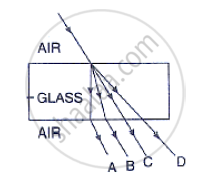
In figure , name the ray which represents the correct path of light while emerging out through
a glass block.
Draw a diagram to represent the second focus of a convex lens.
A convex lens forms an image of an object equal to the size of the object. State two more characteristics of the image.
When you focus the image of a distant flag, whose shape is given below, on a screen using a convex lens, the shape of the image as it appears on the screen is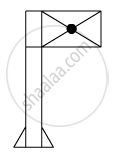
(A)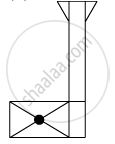
(B)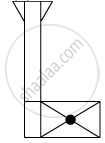
(C)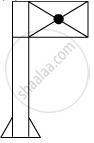
(D)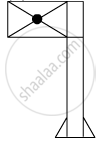
While determining the focal length of a convex lens, you try to focus the image of a distant object formed by the lens on the screen. The image formed on the screen, as compared to the object, should be
(A) erect and highly diminished
(B) erect and enlarged
(C) inverted and enlarged
(D) inverted and highly diminished
State two applications of a convex lens.
Define the terms principal foci and focal lengths as applied to a convex lens, and show them with the help of proper diagrams.
Find the odd one out and give its explanation.
Distinguish between:
Concave lens and Convex Lens
Distinguish between Concave lens and Convex Lens.
