Advertisements
Advertisements
Question
_______ is a combination of two convex lenses with small focal length.
Options
simple microscope
compound microscope
telescope
none of these
Advertisements
Solution
Compound microscope is a combination of two convex lenses with small focal length.
APPEARS IN
RELATED QUESTIONS
An object 5 cm in length is held 25 cm away from a converging lens of focal length 10 cm. Draw the ray diagram and find the position, size and the nature of the image formed.
Analyse the following observation table showing variation of image-distance (v) with object-distance (u) in case of a convex lens and answer the questions that follow without doing any calculations :
| S. No. | Object-Distance u (cm) |
Image-Distance v (cm) |
| 1 | –100 | +25 |
| 2 | –60 | +30 |
| 3 | –40 | +40 |
| 4 | –30 | +60 |
| 5 | –25 | +100 |
| 6 | –15 | +120 |
(a) What is the focal length of the convex lens? Give reason to justify your answer.
(b) Write the serial number of the observation which is not correct. On what basis have you arrived at this conclusion?
(c) Select an appropriate scale and draw a ray diagram for the observation at S.No. 2. Also find the approximate value of magnification.
When a ray of light enters from one medium to another having different optical densities it bends. Why does this phenomenon occur?
Draw a ray diagram to show the formation of the image of an object be placed so that a real and inverted image of the same size as the object is obtained using a convex lens
Draw a labelled ray diagram to show how a ray of light passes through a parallel-sided glass block if it hits the glass block at an angle other than 90° (that is, obliquely to the glass block).
Define the principal axis of a convex lens.
Describe with the help of a ray-diagram, the formation of image of a finite object placed in front of convex lens between f and 2f. Give two characteristics of the image so formed.
Which of the above two cases illustrates the working of a magnifying glass?
Find the nature, position and magnification of the images formed by a convex lens of focal length 0.20 m if the object is placed at a distance of:
0.15 m
A camera fitted with a lens of focal length 50 mm is being used to photograph a flower that is 5 cm in diameter. The flower is placed 20 cm in front of the camera lens.
- At what distance from the film should the lens be adjusted to obtain a sharp image of the flower?
- What would be the diameter of the image of the flower on the film?
- What is the nature of camera lens?
Which part causes the greatest convergence?
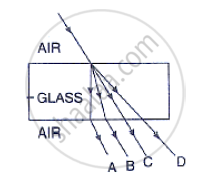
In figure , name the ray which represents the correct path of light while emerging out through
a glass block.
In the following cases, where must an object be placed in front of a convex lens so that the image formed is upright and enlarged?
A convex lens has a divergent action and a concave lens has a convergent action.
For which position of the object does a convex lens form a virtual and erect image? Explain with the help of a ray diagram.
A convex lens forms an inverted image of size same as that of the object which is placed at a distance 60 cm in front of the lens. Find: The position of image
Point out the difference between a convex lens and a concave lens.
A candle is placed between f and 2f a convex lens. Draw a ray diagram showing the position of the image.
Find the odd one out and give its explanation.
Convex lens is also known as ______.
