Advertisements
Advertisements
प्रश्न
_______ is a combination of two convex lenses with small focal length.
विकल्प
simple microscope
compound microscope
telescope
none of these
Advertisements
उत्तर
Compound microscope is a combination of two convex lenses with small focal length.
APPEARS IN
संबंधित प्रश्न
A student is using a convex lens of focal length 18 cm to study the image formation by it for the various positions of the object. He observes that when he places the object at 27 cm, the location of the image is at 54 cm on the other side of the lens. Identify from the following diagram the three rays that are obeying the laws of refraction and may be used to draw the corresponding ray diagram.

(A) 1, 2 and 4
(B) 1, 3 and 5
(C) 2, 4 and 5
(D) 2, 3 and 4
A student focuses the image of a well-illuminated distant object on a screen using a convex lens. After that, he gradually moves the object towards the lens and each time focuses its image on the screen by adjusting the lens.
(i) In which direction, towards the screen or away from the screen, does he move the lens?
(ii) What happens to the size of the image? Does it decrease or increase?
(iii) What happens to the image on the screen when he moves the object very close to the lens?
Which of the following lenses would you prefer to use while reading small letters found in a dictionary?
An object 5 cm in length is held 25 cm away from a converging lens of focal length 10 cm. Draw the ray diagram and find the position, size and the nature of the image formed.
An object is placed at a distance of 15 cm from a concave lens of focal length 30 cm. List four characteristics (nature, position, etc.) of the image formed by the lens.
Draw a labelled ray diagram to show how a ray of light is refracted when it passes:
from an optically denser medium into air.
An object is placed at a distance equal to 2f in front of a convex lens. Draw a labelled ray diagram to show the formation of image. State two characteristics of the image formed.
Name one simple optical instrument in which the above arrangement of convex lens is used.
What is the position of image when an object is placed at a distance of 10 cm from a convex lens of focal length 10 cm?
A student did an experiment with a convex lens. He put an object at different distances 25 cm, 30 cm, 40 cm, 60 cm and 120 cm from the lens. In each case he measured the distance of the image from the lens. His results were 100 cm, 24 cm, 60 cm, 30 cm and 40 cm, respectively. Unfortunately his results are written in wrong order.
What is the focal length of this lens?
What type of images can a convex lens make?
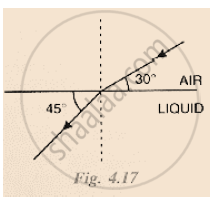
The diagram alongside shows the refraction of a ray of light from sir to a liquid.
(a) write the values of (i) angle of incidence, (ii) angle of refraction.
(b) use snell’s law to find the refractive index of liquid with respect to air.
To find the image distance for varying object distances in case of a convex lens of focal length 15 cm, a student obtains on a screen a sharp image of a bright object by placing it at 20 cm distance from the lens. After that he gradually moves the object away from the lens and each time focuses the image on the screen.
(a) In which direction-towards or away from the lens does he move the screen to focus the object?
(b) How does the size of image change?
(c) Approximately at what distance does he obtain the image of magnification –1?
(d) How does the intensity of image change as the object moves farther and farther away from the lens?
For which position of the object does a convex lens form a virtual and erect image? Explain with the help of a ray diagram.
Where should an object be placed in front of a convex lens to get a real image of the size of the object?
State the nature and position of the object on the principal axis to obtain a real image of the same size
Which lens can produce a real and inverted image of an object?
How will you determine the focal length of a convex lens by the plane mirror method?
Write scientific reason.
Adults need bifocal lens spectacle.
Distinguish between:
Concave lens and Convex Lens
