Advertisements
Advertisements
प्रश्न
_______ times larger images can be obtained by using a simple microscope.
पर्याय
5
10
20
60
Advertisements
उत्तर
20 times larger images can be obtained by using a simple microscope.
APPEARS IN
संबंधित प्रश्न
An object of height 2.5 cm is placed at a distance of 15 cm from the optical centre 'O' of a convex lens of focal length 10 cm. Draw a ray diagram to find the position and size of the image formed. Mark optical 'O', principal focus F and height of the image on the diagram.
A student focuses the image of a well-illuminated distant object on a screen using a convex lens. After that, he gradually moves the object towards the lens and each time focuses its image on the screen by adjusting the lens.
(i) In which direction, towards the screen or away from the screen, does he move the lens?
(ii) What happens to the size of the image? Does it decrease or increase?
(iii) What happens to the image on the screen when he moves the object very close to the lens?
One-half of a convex lens is covered with a black paper. Will this lens produce a complete image of the object? Verify your answer experimentally. Explain your observations.
An object is placed at a distance of 15 cm from a convex lens of focal length 20 cm. List four characteristics (nature, position, etc.) of the image formed by the lens.
Where should an object be placed in front of a convex lens so as to obtain its virtual, erect and magnified image?
Draw a ray diagram to show the formation of a real magnified image by a convex lens. (In your sketch the position of object and image with respect to the principal focus of lens should be shown clearly).
You eye contains a convex lens. Why is it unwise to look at the sun?
An object is placed f and 2f of a convex lens. Which of the following statements correctly describes its image?
(a) real, larger than the object
(b) erect, smaller than the object
(c) inverted, same size as object
(d) virtual, larger than the object
- An object 3 cm high is placed 24 cm away from a convex lens of focal length 8 cm. Find by calculations, the position, height and nature of the image.
- If the object is moved to a point only 3 cm away from the lens, what is the new position, height and nature of the image?
- Which of the above two cases illustrates the working of a magnifying glass?
A student did an experiment with a convex lens. He put an object at different distances 25 cm, 30 cm, 40 cm, 60 cm and 120 cm from the lens. In each case he measured the distance of the image from the lens. His results were 100 cm, 24 cm, 60 cm, 30 cm and 40 cm, respectively. Unfortunately his results are written in wrong order.
- Rewrite the image distances in the correct order.
- What would be the image distance if the object distance was 90 cm?
- Which of the object distances gives the biggest image?
- What is the focal length of this lens?
What would be the diameter of the image of the flower on the film?
What kind of lens is used to correct
long-sightedness?
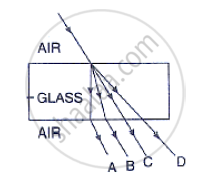
In figure , name the ray which represents the correct path of light while emerging out through
a glass block.
List four properties of the image formed by a convex mirror.
State two applications of a convex lens.
Write the three characteristics of the image formed by a convex lens of focal length 20 cm for the object at distance (i) 10 cm, (ii) 30 cm, (iii) 40 cm, (iv) 60 cm from the lens.
In sunglasses, both of its surfaces are curved, yet their behaviour is neither like a convex lens nor like a concave lens. State the reason.
Find the odd one out and give its explanation.
Distinguish between:
Concave lens and Convex lens
