Advertisements
Advertisements
Question
Complete the following table:
| Instrument | Number of Convex Lenses |
Use |
| Simple Microscope | .............. | .............. |
| Compound Microscope | .............. | .............. |
| Telescope | .............. | .............. |
Advertisements
Solution
| Instrument | Number of Convex Lenses |
Use |
| Simple Microscope | 1 | Used by watch repairers to view tiny watch parts |
| Compound Microscope | 2 | Used by watch repairers to view tiny watch parts |
| Telescope | 2 | Used to view faraway objects in outer space |
APPEARS IN
RELATED QUESTIONS
(a) Draw a ray diagram to show the formation of an image by a convex lens when an object is placed in front of the lens between its optical centre and principal focus.
(b) In the above ray diagram, mark the object distance (u) and the image distance (v) with their proper signs (+ve or –ve as per the new Cartesian sign convention) and state how these distances are related to the focal length (f) of the convex lens in this case.
(c) Find the power of a convex lens which forms a real and inverted image of magnification –1 of an object placed at a distance of 20 cm from its optical centre.
A beam of light travelling in a rectangular glass slab emerges into air. Draw a ray-diagram indicating the change in its path.
Where should an object be placed in order to use a convex lens as a magnifying glass?
Draw a ray diagram to show the formation of a real magnified image by a convex lens. (In your sketch the position of object and image with respect to the principal focus of lens should be shown clearly).
Describe with the help of a ray-diagram, the formation of image of a finite object placed in front of convex lens between f and 2f. Give two characteristics of the image so formed.
A convex lens of focal length 8 cm forms a real image of the same size as the object. The distance between object and its image will be:
In the following cases, where must an object be placed in front of a convex lens so that the image formed is inverted and enlarged?
State two applications of a convex lens.
Point out the difference between a convex lens and a concave lens.
State the position of object, position of image, nature of image when: Convex lens is used as objective lens of astronomical telescope.
State the position of object, position of image, nature of image when: Convex lens is used as objective lens of photographic camera.
Where should an object be placed in front of a convex lens so as to form an inverted and enlarged image? Will the image be real or virtual? Draw a ray diagram to illustrate your answer.
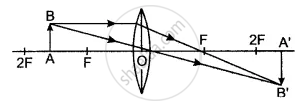
Draw a ray diagram to illustrate the determination of the focal length of a convex lens using an auxiliary plane mirror.
An object is placed in front of a convex lens such that the image formed has the same size as that of the object. Draw a ray diagram to illustrate this.
For a specific glass lens f = 0.5 m. This is the only information given to the student. Which type of lens is given to him and what is its power?
Object at 2F1 of a convex lens : Image at 2F2 : : Object at F1 : _______
Find the odd one out and give its explanation.
 |
 |
The above images are that of a specialized slide projector. Slides are small transparencies mounted in sturdy frames ideally suited to magnification and projection since they have a very high resolution and a high image quality. There is a tray where the slides are to be put into a particular orientation so that the viewers can see the enlarged erect images of the transparent slides. This means that the slides will have to be inserted upside down in the projector tray.
To show her students the images of insects that she investigated in the lab, Mrs. Iyer brought a slide projector. Her slide projector produced 500 times enlarged and inverted image of a slide on a screen 10 m away.
a. Based on the text and data given in the above paragraph, what kind of lens must the slide projector have?
b. If v is the symbol used for image distance and u for object distance then with one reason state what will be the sign for `"𝑣"/"𝑢"` in the given case?
c. A slide projector has a convex lens with a focal length of 20 cm. The slide is placed upside down 21 cm from the lens. How far away should the screen be placed from the slide projector’s lens so that the slide is in focus?
OR
c. When a slide is placed 15 cm behind the lens in the projector, an image is formed 3 m in front of the lens. If the focal length of the lens is 14 cm, draw a ray diagram to show image formation. (not to scale)
Distinguish between Concave lens and Convex lens.
Distinguish between Concave lens and Convex Lens.
