Advertisements
Advertisements
Questions
Distinguish between:
Concave lens and Convex lens
State the differences between images formed by a convex and a concave lens.
Advertisements
Solution
| Concave lens | Convex lens | |
| 1. | It is a diverging lens because it diverges the rays falling on it. | It is a converging lens because it converges the rays falling on it. |
| 2. | It is thin at the center and bulged at the edge. | It is thin at the edge and bulged at the centre. |
| 3. | The image formed by concave lens is always diminished and virtual. | The image formed by convex lens can be real as well as virtual. Also, the image formed can be diminished as well as magnified. |
| 4. | It has a virtual focus. | It has a real focus. |
APPEARS IN
RELATED QUESTIONS
One-half of a convex lens is covered with a black paper. Will this lens produce a complete image of the object? Verify your answer experimentally. Explain your observations.
An object is placed at a distance of 15 cm from a concave lens of focal length 30 cm. List four characteristics (nature, position, etc.) of the image formed by the lens.
"A lens can form a magnified erect image as well as magnified inverted image of an object placed in front of it." State the nature of this lens and draw ray diagrams to justify the above statement. Mark the positions of O, F and 2F in the diagram.
An object of height 4.0 cm is placed at a distance of 30 cm from the optical centre 'O' of a convex lens of focal length 20 cm. Draw a ray diagram to find the position and size of the image formed. Mark optical centre 'O' and principal focus 'F' on the diagram. Also find the approximate ratio of size of the image to the size of the object.
Draw a ray diagram to show the formation of a real magnified image by a convex lens. (In your sketch the position of object and image with respect to the principal focus of lens should be shown clearly).
How could you find the focal length of a convex lens rapidly but approximately?
A convex lens of focal length 6 cm is held 4 cm from a newspaper which has print 0.5 cm high. By calculation, determine the size and nature of the image produced.
- An object 3 cm high is placed 24 cm away from a convex lens of focal length 8 cm. Find by calculations, the position, height and nature of the image.
- If the object is moved to a point only 3 cm away from the lens, what is the new position, height and nature of the image?
- Which of the above two cases illustrates the working of a magnifying glass?
If the object is moved to a point only 3 cm away from the lens, what is the new position, height and nature of the image?
Study the diagram below.
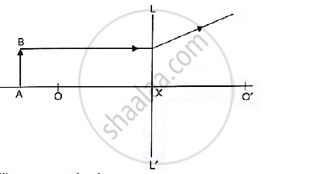
what are the points O, O’ called?
In the following cases, where must an object be placed in front of a convex lens so that the image formed is of the same size as the object?
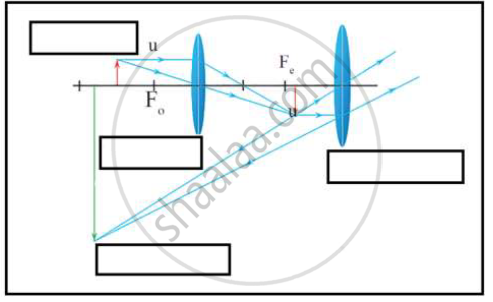
i. Which type of microscope has the arrangement of lenses shown in the adjoining figure?
ii. Label the figure correctly.
iii. Write the working of this microscope.
iv. Where does this microscope used?
v. Suggest a way to increase the efficiency of this microscope.
What is the difference between a double convex and a bi-convex lens?
What happens to the image formed by a convex lens if its lower part is blackened?
Can a normal convex lens behave like a concave lens and vice-versa?
Where should an object be placed in front of a convex lens so as to form an inverted and enlarged image? Will the image be real or virtual? Draw a ray diagram to illustrate your answer.
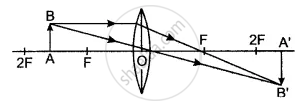
Diagram shows an object AB placed on the principal axis B of a convex lens placed in air. F1 and F2 are the two foci of the lens.
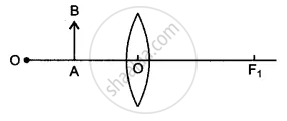
(i) Copy the diagram:
Draw a ray of light starting from B and passing through O. Show the same ray after refraction by the lens. Draw another ray from B which passes through F2 after refraction by the lens. Locate the final image
(ii) Is the image real or virtual?
Find the odd one out and give its explanation.
Distinguish between:
Concave lens and Convex Lens
