Advertisements
Online Mock Tests
Chapters
![Balbharati solutions for Science and Technology Part 1 [English] Standard 10 Maharashtra State Board chapter 7 - Lenses - Shaalaa.com](/images/science-and-technology-part-1-english-standard-10-maharashtra-state-board_6:c9a4ae86c3724b9b8c519cd188fdfa1f.jpg "Balbharati solutions for Science and Technology Part 1 [English] Standard 10 Maharashtra State Board chapter 7 - Lenses")
Advertisements
Solutions for Chapter 7: Lenses
Below listed, you can find solutions for Chapter 7 of Maharashtra State Board Balbharati for Science and Technology Part 1 [English] Standard 10 Maharashtra State Board.
Balbharati solutions for Science and Technology Part 1 [English] Standard 10 Maharashtra State Board 7 Lenses Intext Questions [Pages 80 - 91]
Can you recall?
Indicate the following terms related to spherical mirrors in the given figure: poles, centre of curvature, radius of curvature, principal focus.
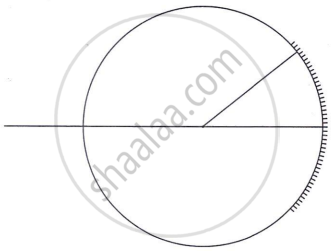
How are concave and convex mirrors constructed?
Can you recall?
What is a real image?
What is a virtual image?
How will you find out whether an image is real or virtual? Can a virtual image be obtained on a screen?
Can you recall?
What is the Cartesian sign convention used for spherical mirrors?
Use your brain power!
From the equations given below, what is the relation between h1, h2, u and v?
`"Magnification" = "Height of the Image"/"Height of the object" "i.e. M" = (h_2)/(h_1)`
`"Magnification" = "Distance of the Image"/"Distance of the object" "i.e. M" = v/u`
Use your brain power!
Why do we have to bring a small object near the eyes in order to see it clearly?
If we bring an object closer than 25 cm from the eyes, why can we not see it clearly even though it subtends a bigger angle at the eye?
Can you tell?
How do we perceive different colours?
Balbharati solutions for Science and Technology Part 1 [English] Standard 10 Maharashtra State Board 7 Lenses Exercise [Page 92]
Match the columns in the following table and explain them.
| Column 1 | Column 2 | Column 3 |
| Farsightedness |
Nearby object can be seen clearly
|
Bifocal lens |
| Presbyopia | Far away object can be seen clearly | Concave lens |
| Nearsightedness | Problem of old age | Convex lens |
Draw a figure explaining various terms related to a lens.
At which position will you keep an object in front of a convex lens so as to get a real image of the same size as the object? Draw a figure.
Give a scientific reason.
Simple microscope is used for watch repairs.
Give scientific reason:
One can sense colours only in bright light.
Give scientific reason:
We cannot clearly see an object kept at a distance less than 25 cm from the eye.
Explain the working of an astronomical telescope using refraction of light.
Distinguish between:
Farsightedness and Nearsightedness.
Distinguish between:
Concave lens and Convex lens
What is the function of iris and the muscles connected to the lens in human eye?
Solve the following example.
Doctor has prescribed a lens having power +1.5 D. What will be the focal length of the lens? What is the type of the lens and what must be the defect of vision?
Solve the following example.
5 cm high object is placed at a distance of 25 cm from a converging lens of focal length of 10 cm. Determine the position, size and type of the image.
Solve the following example.
Three lenses having power 2, 2.5 and 1.7 D are kept touching in a row. What is the total power of the lens combination?
Solve the following example.
An object kept 60 cm from a lens gives a virtual image 20 cm in front of the lens. What is the focal length of the lens? Is it a converging lens or diverging lens?
Solutions for 7: Lenses
Balbharati solutions for Science and Technology Part 1 [English] Standard 10 Maharashtra State Board chapter 7 - Lenses
Shaalaa.com has the Maharashtra State Board Mathematics Science and Technology Part 1 [English] Standard 10 Maharashtra State Board Maharashtra State Board solutions in a manner that help students grasp basic concepts better and faster. The detailed, step-by-step solutions will help you understand the concepts better and clarify any confusion. Balbharati solutions for Mathematics Science and Technology Part 1 [English] Standard 10 Maharashtra State Board Maharashtra State Board 7 (Lenses) include all questions with answers and detailed explanations. This will clear students' doubts about questions and improve their application skills while preparing for board exams.
Further, we at Shaalaa.com provide such solutions so students can prepare for written exams. Balbharati textbook solutions can be a core help for self-study and provide excellent self-help guidance for students.
Concepts covered in Science and Technology Part 1 [English] Standard 10 Maharashtra State Board chapter 7 Lenses are Power of a Lens, Defects of Vision and Their Corrections > Hypermetropia, Defects of Vision and Their Corrections > Presbyopia, Images Formed by Convex Lenses, Combination of Lenses, Defects of Vision and Their Corrections > Myopia, Concept of Lenses, Images Formed by Concave Lenses, Lens Formula, Magnification, Apparent Size of an Object, Use of Concave Lenses, Use of Convex Lenses, Persistence of Vision, Coordinate Geometry Sign Convention for Measuring Distances and Lengths.
Using Balbharati Science and Technology Part 1 [English] Standard 10 Maharashtra State Board solutions Lenses exercise by students is an easy way to prepare for the exams, as they involve solutions arranged chapter-wise and also page-wise. The questions involved in Balbharati Solutions are essential questions that can be asked in the final exam. Maximum Maharashtra State Board Science and Technology Part 1 [English] Standard 10 Maharashtra State Board students prefer Balbharati Textbook Solutions to score more in exams.
Get the free view of Chapter 7, Lenses Science and Technology Part 1 [English] Standard 10 Maharashtra State Board additional questions for Mathematics Science and Technology Part 1 [English] Standard 10 Maharashtra State Board Maharashtra State Board, and you can use Shaalaa.com to keep it handy for your exam preparation.
