Advertisements
Advertisements
प्रश्न
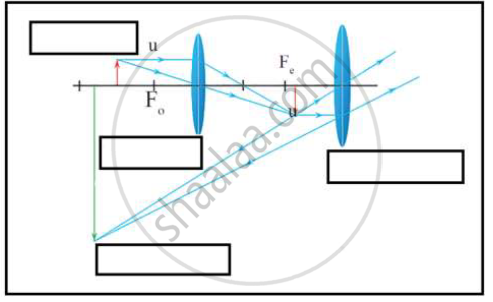
i. Which type of microscope has the arrangement of lenses shown in the adjoining figure?
ii. Label the figure correctly.
iii. Write the working of this microscope.
iv. Where does this microscope used?
v. Suggest a way to increase the efficiency of this microscope.
Advertisements
उत्तर
i. Compound microscope
ii. Scientifically and technically correct figure.
(Object, Objective lens, Eye piece, Image)
iii. Magnification is obtained by the combined effect of two
lenses. The magnification occurs in two stages. The image formed by the first lens acts as the object for the second lens. Clear image can be obtained by adjusting the distance between two lenses.
iv. To study small sized objects like blood cells, animal and plant
cells, bacteria.
v. Any relevant remedy (For example, Selection of lens with
appropriate focal length)
APPEARS IN
संबंधित प्रश्न
"A lens can form a magnified erect image as well as magnified inverted image of an object placed in front of it." State the nature of this lens and draw ray diagrams to justify the above statement. Mark the positions of O, F and 2F in the diagram.
A beam of light travelling in air is incident of water. Draw a ray-diagram indicating the change in its path in water.
The diagram given alongside shows a ray of light entering a rectangular block of glass.
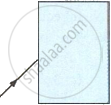
- Copy the diagram and draw the normal at the point of entry.
- Draw the approximate path of the ray of light through the glass block and out of the other side.
Draw a labelled ray diagram to show how a ray of light passes through a parallel-sided glass block if it hits the glass block at an angle other than 90° (that is, obliquely to the glass block).
If the image formed by a convex lens is of the same size as that of the object, what is the position of the image with respect to the lens?
Describe with the help of a ray-diagram, the formation of image of a finite object placed in front of convex lens between f and 2f. Give two characteristics of the image so formed.
A convex lens of focal length 0.10 m is used to form a magnified image of an object of height 5 mm placed at a distance of 0.08 m from the lens. Calculate the position, nature and size of the image.
Which of the above two cases illustrates the working of a magnifying glass?
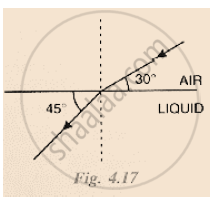
The diagram alongside shows the refraction of a ray of light from sir to a liquid.
(a) write the values of (i) angle of incidence, (ii) angle of refraction.
(b) use snell’s law to find the refractive index of liquid with respect to air.
Out of the five incident rays shown in the figure find the three rays that are obeying the laws of refraction and may be used for locating the position of image formed by a convex lens:
(A) 1, 2 and 3
(B) 2, 3 and 4
(C) 3, 4 and 5
(D) 1, 2 and 4
An object is placed perpendicular to the principal axis of a convex lens of focal length 20 cm. The distance of the object from the lens is 30 cm. Find (i) the position (ii) the magnification and (iii) the nature of the image formed.
For which position of the object does a convex lens form a virtual and erect image? Explain with the help of a ray diagram.
The image obtained while finding the focal length of convex lens is ....................
Observe the following figure and complete the table:

| Points | Answer |
| (i) Position of the object | |
| (ii) Position of the image | |
| (iii) Size of the image | |
| (iv) Nature of the image |
State the nature and position of the object on the principal axis to obtain a virtual and magnified image.
Which lens can produce a real and inverted image of an object?
Can a normal convex lens behave like a concave lens and vice-versa?
How will you determine the focal length of a convex lens by the plane mirror method?
Define the terms principal foci and focal lengths as applied to a convex lens, and show them with the help of proper diagrams.
Find the odd one out and give its explanation.
