Advertisements
Advertisements
Question
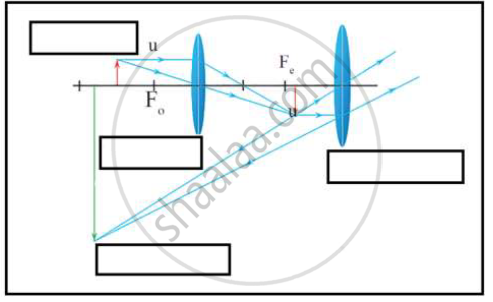
i. Which type of microscope has the arrangement of lenses shown in the adjoining figure?
ii. Label the figure correctly.
iii. Write the working of this microscope.
iv. Where does this microscope used?
v. Suggest a way to increase the efficiency of this microscope.
Advertisements
Solution
i. Compound microscope
ii. Scientifically and technically correct figure.
(Object, Objective lens, Eye piece, Image)
iii. Magnification is obtained by the combined effect of two
lenses. The magnification occurs in two stages. The image formed by the first lens acts as the object for the second lens. Clear image can be obtained by adjusting the distance between two lenses.
iv. To study small sized objects like blood cells, animal and plant
cells, bacteria.
v. Any relevant remedy (For example, Selection of lens with
appropriate focal length)
APPEARS IN
RELATED QUESTIONS
"A convex lens can form a magnified erect as well as magnified inverted image of an object placed in front of it." Draw ray diagram to justify this statement stating the position of the object with respect to the lens in each case.
An object 5 cm is placed at a distance of 20 cm in front of a convex mirror of radius of curvature 30 cm. Find the position, nature and size of the image.
Study the given ray diagrams and select the correct statement from the following:
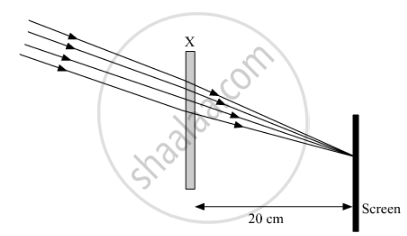
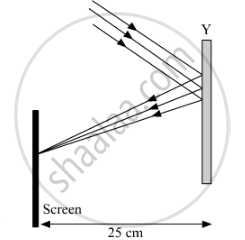
(A) Device X is a concave mirror and device Y is a convex lens, whose focal lengths are 20 cm and 25 cm respectively.
(B) Device X is a convex lens and device Y is a concave mirror, whose focal lengths are 10 cm and 25 cm respectively.
(C) Device X is a concave lens and device Y is a convex mirror, whose focal lengths are 20 cm and 25 cm respectively.
(D) Device X is a convex lens and device Y is a concave mirror, whose focal lengths are 20 cm and 25 cm respectively.
Draw a labelled ray diagram to show the angle of incidence and the angle of refraction for a refracted ray of light.
If the image formed by a convex lens is of the same size as that of the object, what is the position of the image with respect to the lens?
What type of lens would you use as a magnifying glass? How close must the object be to the lens?
A convex lens has a focal length of 10 cm. At which of the following positions should an object be placed so that this convex lens may act as a magnifying glass?
A convex lens produces an inverted image magnified three times of an object placed at a distance of 15 cm from it. Calculate the focal length of the lens.
If the object is moved to a point only 3 cm away from the lens, what is the new position, height and nature of the image?
A student did an experiment with a convex lens. He put an object at different distances 25 cm, 30 cm, 40 cm, 60 cm and 120 cm from the lens. In each case he measured the distance of the image from the lens. His results were 100 cm, 24 cm, 60 cm, 30 cm and 40 cm, respectively. Unfortunately his results are written in wrong order.
What is the focal length of this lens?
A beam of parallel light rays is incident through the holes on one side of a box and emerges out through the holes on its opposite side as shown in the diagram below:
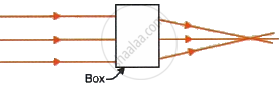
Which of the following could be inside the box?
In the following cases, where must an object be placed in front of a convex lens so that the image formed is upright and enlarged?
An object is placed perpendicular to the principal axis of a convex lens of focal length 20 cm. The distance of the object from the lens is 30 cm. Find (i) the position (ii) the magnification and (iii) the nature of the image formed.
Where should an object be placed in front of a convex lens to get a real image of the size of the object?
State the position of object, position of image, nature of image when: Convex lens is used as objective lens of photographic camera.
What happens to the image formed by a convex lens if its lower part is blackened?
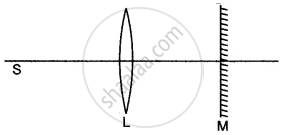
In the figure given below L is a convex lens, M is a plane mirror and S is a point source of light. Rays of light from the source S return to their point of origin. Complete the ray diagram to show this. What is the point S called?
Find the odd one out and give its explanation.
Distinguish between Concave lens and Convex Lens.
