Advertisements
Advertisements
Question
The image obtained while finding the focal length of convex lens is ....................
Options
a) a real and erect.
b) virtual and erect.
c) real and inverted.
d) virtual and inverted.
Advertisements
Solution
c) real and inverted.
APPEARS IN
RELATED QUESTIONS
Draw a ray diagram to show the formation of image in the above situation
An object 5 cm in length is held 25 cm away from a converging lens of focal length 10 cm. Draw the ray diagram and find the position, size and the nature of the image formed.
If you focus the image of a distant object, whose shape is given below, on a screen using a convex lens, the shape of the image of this object on the screen would be:
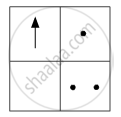
(a)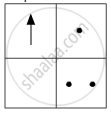
(b)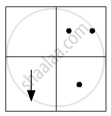
(c)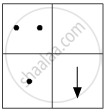
(d)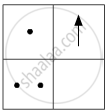
A ray of light travelling in air is incident on a parallel-sided glass slab (or rectangular glass slab). Draw a ray-diagram indicating the change in its path in glass.
The diagram given alongside shows a ray of light entering a rectangular block of glass.
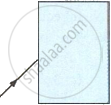
- Copy the diagram and draw the normal at the point of entry.
- Draw the approximate path of the ray of light through the glass block and out of the other side.
How could you find the focal length of a convex lens rapidly but approximately?
With the help of a labelled diagram explain how a convex lens converges a beam of parallel light rays. Mark the principal axis, optical centre, principal focus and focal length of the convex lens on the diagram.
A convex lens produces an inverted image magnified three times of an object placed at a distance of 15 cm from it. Calculate the focal length of the lens.
What type of images can a convex lens make?
A beam of parallel light rays is incident through the holes on one side of a box and emerges out through the holes on its opposite side as shown in the diagram below:
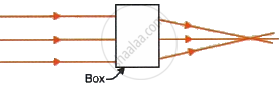
Which of the following could be inside the box?
The diagrams (a) and (b) in Figure below show the refraction of a monochromatic ray of light through a parallel sided glass block and a prism respectively. In each diagram, label the incident, refracted emergent rays and the angle of deviation.

A convex lens forms an image of an object equal to the size of the object. Draw a diagram to illustrate it.
A convex lens forms an image of an object equal to the size of the object. State two more characteristics of the image.
Yesh find out F1 and F2 of symmetric convex lens experimentally then which conclusion is true.
A lens always forms an image between the object and the lens.
A lens always forms an image between the object and the lens.
The focal length of a lens is positive. In this case, state the kind of lens.
How will you decide whether a given piece of glass is a concave lens, convex lens, or a plane glass plate?
A concave mirror and convex lens are held in water. What changes, if any, do you expect in their focal length?
We can burn a piece of paper by focussing the sun rays by using a particular type of lens. Name the type of lens used for the above purpose. Draw a ray diagram to support your answer.
For a specific glass lens f = 0.5 m. This is the only information given to the student. Which type of lens is given to him and what is its power?
