Advertisements
Advertisements
Question
Observe the following figure which bulb get fuse?

Advertisements
Solution
Bulb A
APPEARS IN
RELATED QUESTIONS
Redraw the circuit of question 1, putting in an ammeter to measure the current through the resistors and a voltmeter to measure the potential difference across the 12 Ω resistors. What would be the readings in the ammeter and the voltmeter?
Draw circuit symbols for
fixed resistance
Draw circuit symbols for
A closed switch
Draw the labelled diagram of an electric circuit comprising of a cell, a resistance, an ammeter, a voltmeter and a closed switch (or closed plug key). Which of the two has a large resistance : an ammeter or a voltmeter?
Tell the odd one out. Give a proper explanation.
Match the column ‘A’ with column ‘B’.
|
Column ‘A’
|
Column ‘B’ |
|
(1) Eka - boron
|
(a) Germanium
|
|
(2) Eka - Aluminium
|
(b) Scandium
|
|
(3) Eka - Silicon
|
(c) Gallium |
Answer the following question.
With the help of a suitable circuit diagram prove that the reciprocal of the equivalent resistance of a group of resistances joined in parallel is equal to the sum of the reciprocals of the individual resistances.
What do you understand by the open electric circuit?
Explain the following:
Open circuit
If you touch an electric wire carrying current you get a shock, but if on the same wire the birds sit they do not get any shock/current. Explain why?
Right or wrong sentence.
Increasing the current passing through the wire decreases the magnetic field intensity.
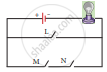
In the circuit shown, which switches (L,M or N) must be closed to light up the bulb?
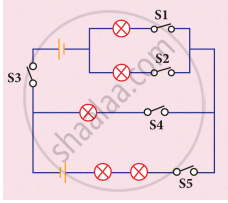
Study the electric circuit below. Which of the following switches should be closed so that only two bulbs will light up
_____ has a thin metallic filament that melts and breaks the connection when the circuit is overheated.
Assertion: People struck by lightning receive a severe electrical shock.
Reason: Lightning carries very high voltage.
What is electric circuit?
When a circuit is open, _____ cannot pass through it.
Explain about domestic electric circuits. (circuit diagram not required)
Assertion: In an open circuit, the current passes from one terminal of the electric cell to another.
Reason: Generally, the metal disc of a cell acts as a positive terminal.
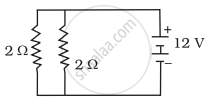
In the following circuits (Figure), heat produced in the resistor or combination of resistors connected to a 12 V battery will be
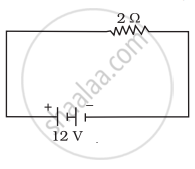 |
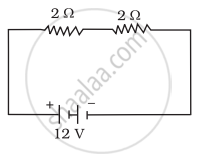 |
 |
| (i) | (ii) | (iii) |
In an electrical circuit two resistors of 2 Ω and 4 Ω respectively are connected in series to a 6 V battery. The heat dissipated by the 4 Ω resistor in 5 s will be
In an electric circuit, the current starts from ______.
When an electric current flows through a copper wire AB as shown in the following figure, the wire

Our body is a ______ of electricity.
The ______ is a species of fish that can give electric shocks of up to six hundred fifty watts of electricity.
Match the following
| 1. | Insulator | a. | Coulomb |
| 2. | Conductor | b. | Electric circuit |
| 3. | Closed path | c. | Copper |
| 4. | Electric charge | d. | Rubber |
Paheli is running short of connecting wires. To complete an electric circuit, she may use a ______.
Paheli connected two bulbs to a cell as shown in the following figure.
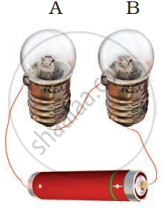
She found that filament of bulb B is broken. Will the bulb A glow in this circuit? Give reason.
Write a short note on the different electrical circuits.
Name the device which is used to measure the strength of the electric current in an electric circuit.
A complete circuit is left on for several minutes, causing the connecting copper wire to become hot. As the temperature of the wire increases, the electrical resistance of the wire
How is Joule's law effect useful in electric circuits where fuse is used as a safety device?
