Advertisements
Advertisements
Question
Light changes its direction when going from one transparent medium to another transparent medium. This is called _______.
Options
Reflection of light
Refraction of light
Dispersion of light
Aabsorption of light
Scattering of light
Advertisements
Solution
Light changes its direction when going from one transparent medium to another transparent medium. This is called refraction of light.
Explanation:
- When light travels through a transparent material, like glass or water, it bends, a phenomenon known as refraction.
- This occurs because light travels at various speeds through different optical densities.
APPEARS IN
RELATED QUESTIONS
Name the phenomenon responsible for the following effect:
When we sit in front of a plane mirror and write with our right hand, it appears in the mirror that we are writing with the left hand.
What is the difference between regular reflection of light and diffuse reflection of light?
The boy walks towards the mirror at a speed of 1 m/s. At what speed does his image approach him?
An extended object in the form of an arrow pointing upward has been placed in front of a plane mirror. Draw a labelled ray-diagram to show the formation of its image.
Name the phenomenon due to which a swimming pool appears less deep than it really is.
What is meant by ‘refraction of light’?
What is meant by the ‘angle of incidence’ for a ray of light?
Light travels more quickly through water than through glass.
- Which is optically denser: water or glass?
- If a ray of light passes from glass into water, which way will it bend: towards the normal or away from the normal?
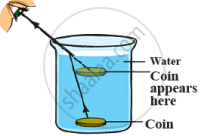
A coin in a glass tumbler appears to rise as the glass tumbler is slowly filled with water. Name the phenomenon responsible for this effect.
When a ray of light travelling in glass enters into water obliquely ______.
A ray of light passes from a medium X to another medium Y. No refraction of light occurs if the ray of light hits the boundary of medium Y at an angle of:
(a) 0°
(b) 45°
(c) 90°
(d) 120°
A vertical ray of light strikes the horizontal surface of some water:
What is the angle of refraction?
The speed of light is more in glass than in water.
The depth of a pond when seen from above appears to be less.
What do you understand by refraction of light?
A small air bubble in a glass block when seen from above appears to be raised because of ______.
Fill in the blank and Explain the completed sentences.
The change in ______ of light rays while going from one medium to another is called refraction.
List four characteristics of the image formed by a concave lens of focal length 20 cm when the object is placed at a distance of 40 cm from its optical centre.
The size of image of an object by a convex lens of focal length 20 cm is observed to be reduced to `1/3` rd of its size . Find the distance of the object from the optical centre of the lens .
The phenomenon of change in the direction of light when it passes from one transparent medium to another is called ___________.
A real image is formed by the light rays after reflection or refraction when they:
- actually meet or intersect with each other.
- actually converge at a point.
- appear to meet when they are produced in the backward direction.
- appear to diverge from a point.
Which of the above statements are correct?
Identify the wrong figure from the following.
Observe the given figure and write appropriate phenomenon of light in the box.
Explain with diagrams how refraction of incident light takes place from
- rarer to denser medium
- denser to rarer medium
- normal to the surface separating the two media.
The refractive index of four substances A, B, C, and D are 1.31, 1.43, 1.33, 2.4 respectively. The speed of light is maximum in
The deviation of light ray from its path when it travels from one transparent medium to another transparent medium is called ______.
If a beam of red light and a beam of violet light are incident at the same angle on the inclined surface of a prism from air medium and produce angles of refraction r and v respectively, which of the following is correct?
Which object use the reflection of light?
Which surface will not reflect most of the light falling on them?
When light passes from one medium to another the ray gets bent. This property of light is called ______.
A ray of light traveling in medium 1 strikes and travels into another transparent medium 2. If the speed of light is greater in medium 1, the ray will ______.
A star appears twinkling into the sky because of the reflection of light by the atmosphere.
Which is optically denser out of the two medium M1& M2 having the refractive indices = 1.71 and 1.36 respectively?
The bottom of swimming pool appears to be less deep than the actual one because of
The ray that enters the second medium after crossing the boundary is called the:
When light travels from a rarer medium to a denser medium, its speed:
When light travels from a denser medium to a rarer medium, its speed:
To a crane, a fish appears 6 cm below the water surface. Taking the refractive index of water as \[\frac{4}{3}\], the real depth of the fish below the surface is:
