Advertisements
Advertisements
प्रश्न
Light changes its direction when going from one transparent medium to another transparent medium. This is called _______.
पर्याय
Reflection of light
Refraction of light
Dispersion of light
Aabsorption of light
Scattering of light
Advertisements
उत्तर
Light changes its direction when going from one transparent medium to another transparent medium. This is called refraction of light.
Explanation:
- When light travels through a transparent material, like glass or water, it bends, a phenomenon known as refraction.
- This occurs because light travels at various speeds through different optical densities.
APPEARS IN
संबंधित प्रश्न
A ray of light strikes a plane mirror such that its angle of incidence is 30°. What angle does the reflected ray make with the mirror surface?
What is meant by 'reflection of light'?
State and explain the laws of reflection of light at a plane surface (like a plane mirror), With the help of a labelled ray-diagram. Mark the angles of 'incidence' and 'reflection' clearly on the diagram. If the angle of reflection is 47.5°, what will be the angle of incidence?
The angle of reflection is equal to the angle of incidence:
(a) always
(b) sometimes
(c) under special conditions
(d) never
If a ray of light goes from a rarer medium to a denser medium, will it bend towards the normal or away from it?
If a ray of light goes form a denser medium to a rarer medium, will it bend towards the normal or away from the normal?
A ray of light goes from water into air. Will it bend towards the normal or away from the normal?
Fill in the following blank with suitable word:
Light travelling along a normal is ...............refracted.
What is meant by ‘refraction of light’?
Light travels more quickly through water than through glass.
If a ray of light passes from glass into water, which way will it bend : towards the normal or away from the normal?
A vertical ray of light strikes the horizontal surface of some water:
What is the angle of refraction?
Water is optically denser than glass.
Light travels at a lower speed in water than in air.
Image is formed by a mirror due to refraction of light.
Match the Following
| Column A | Column B |
| (a) white Light | (1) Convex mirror |
| (b) Refraction | (2) Concave mirror |
| (c) Virtual images | (3) refraction |
| (d) Real images | (4) spectrum |
| (e) Prism | (5) ray of light from glass to air |
A light ray suffers reflection and refraction at the boundary in passing from air to water. Draw a neat labelled ray diagram to show it.
A ray of light A incident from air suffers partial reflection and refraction at the boundary of water.
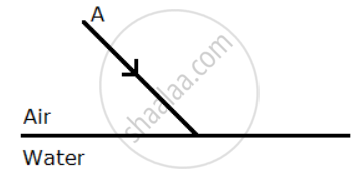
- Complete the diagram showing (i) the reflected ray B and (ii) the refracted ray C.
- How are the angles of incidence i and refraction r related?
Define the principal focus of a concave mirror.
Light enters from air to glass having refractive index 1.50. What is the speed of light in the glass? The speed of light in vacuum is 3 × 10⁸ m s−1.
What is atmospheric reflection? Explain with the help of a labelled diagram that the position of a star as seen by us is not its true position.
The phenomenon of change in the direction of light when it passes from one transparent medium to another is called ___________.
Due to _______ pencil looks bent in water, in the given experiment.
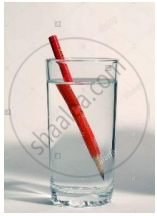
Identify the wrong figure from the following.
The speed of light varies in different media.
Write scientific reason.
A pencil appears to be broken near the surface of water.
The refractive index of a transparent medium is always greater than ______.
Which object use the reflection of light?
How does the light travel?
Light bends as it passes from one medium to another. What is this phenomenon called?
Which is optically denser out of the two medium M1& M2 having the refractive indices = 1.71 and 1.36 respectively?
Why a pencil partly immersed in water appears to be bent at the water surface.
How do twinkling stars occur? (or) what is the cause of the twinkling of stars?
Match the following:
| Column I | Column II | ||
| 1. | r > 90 | a. | Light gazes at the surface of separation between the two modes. |
| 2. | r = 90 | b. | No refraction. |
| 3. | r < 90 | c. | Refracted ray away from the normal |
A ray of light starting from diamond is incident on the interface separating diamond and water. Draw a labelled ray diagram to show. the refraction of light in this case.
The part of light that enters into the other medium and travels in a straight path but in a direction different from its initial direction is called:
When light travels from a rarer medium to a denser medium, its speed:
