Advertisements
Advertisements
प्रश्न
Write a scientific reason.
The coin disappears in a vessel as it is seen from a specific location. But as soon as the water is poured into the vessel to a certain level, the coin appears.
Write a scientific reason.
The coin in the disappeared to have been seen from a specific location. But as soon as the water is poured into the pot to a certain level, the coin appears.
Advertisements
उत्तर
- Light rays coming from the coin emerge out of water and change their direction due to the refraction of light.
- Hence, as soon as the water is poured into the pot to a certain level, the coin appears.
APPEARS IN
संबंधित प्रश्न
What are the important differences between looking at a photograph of your face and looking at yourself in a plane mirror?
A wall reflects light and a mirror also reflects light. What difference is three in the way they reflect light?
An extended object in the form of an arrow pointing upward has been placed in front of a plane mirror. Draw a labelled ray-diagram to show the formation of its image.
Explain why, though both a plane mirror and a sheet of paper reflect light but we can see the image of our face in a plane mirror but not in a sheet of paper.
The image in a plane mirror is virtual and laterally inverted. What does this statement mean?
The angle of reflection is equal to the angle of incidence:
(a) always
(b) sometimes
(c) under special conditions
(d) never
A man stands 10 m in front of a large plane mirror. How far must the walk before he is 5 m away from his image?
A ray of light strikes a plane mirror PQ at an angle of incidence of 30°, is reflected from the plane mirror and then strikes a second plane mirror QR placed at right angles to the first mirror. The angle of reflection at the second mirror is ______.
Explain how to read the following message which was found on some blotting paper:

If a ray of light goes form a denser medium to a rarer medium, will it bend towards the normal or away from the normal?
Name the phenomenon due to which a swimming pool appears less deep than it really is.
In which material do you think light rays travel faster-glass or air?
A ray of light travelling in air is incident on a rectangular glass block and emerges out into the air from the opposite face. Draw a labelled ray diagram to show the completer path of this ray of light. Mark the two points where the refraction of light takes place. What can you say about the final direction of ray of light?
- With the help of a diagram, show how when light falls obliquely on the side of a rectangular glass slab, the emergent ray is parallel to the incident ray.
- Show the lateral displacement of the ray on the diagram.
Explain with the help of a labelled ray diagram, why a pencil partly immersed in water appears to be bent at the water surface. State whether the bending of pencil will increase or decrease if water is replaced by another liquid which is optically more dense than water. Give reason for your answer.
Light travelling from a denser medium to a rarer medium along a normal to the boundary:
(a) is refracted towards the normal
(b) is refracted away from the normal
(c) goes along the boundary
(d) is not refracted
How does the light have to enter the glass:
for no refraction to happen?
A ray of light when passes from glass to air, bends towards the normal.
The depth of a pond when seen from above appears to be less.
Image is formed by a mirror due to refraction of light.
What do you understand by refraction of light?
Draw a diagram showing the refraction of a light ray from water to glass. Label on it the incident ray, the angle of incidence (/), and the angle of refraction (r)
A light ray suffers reflection and refraction at the boundary in passing from air to water. Draw a neat labelled ray diagram to show it.
List in proper sequence the steps of the experiment for determining the approximate focal length of a given concave mirror by obtaining the image of a distant object.
The phenomenon of change in the direction of light when it passes from one transparent medium to another is called ___________.
A real image is formed by the light rays after reflection or refraction when they:
- actually meet or intersect with each other.
- actually converge at a point.
- appear to meet when they are produced in the backward direction.
- appear to diverge from a point.
Which of the above statements are correct?
Due to _______ pencil looks bent in water, in the given experiment.
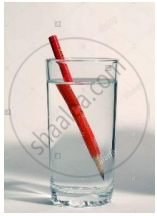
Explain with diagrams how refraction of incident light takes place from
- rarer to denser medium
- denser to rarer medium
- normal to the surface separating the two media.
Numerical problems.
The speed of light in water is 2.25 × 10⁸ ms–1. If the speed of light in vacuum is 3 × 10⁸ ms–1, calculate the refractive index of water.
The deviation of light ray from its path when it travels from one transparent medium to another transparent medium is called ______.
The angle of incidence for a ray of light having zero reflection angle is ______.
A pencil when dipped in water in a glass tumbler appears to be bent at the interface of air and water. Will the pencil appear to be bent to the same extent, if instead of water we use liquids like, kerosene or turpentine. Support your answer with reason.
Which object use the reflection of light?
Twinkling of stars and Mirage are the two phenomena occurring due to refraction.
The ray that enters the second medium after crossing the boundary is called the:
When light passes from one transparent medium to another, its direction changes due to:
In the formula for absolute refractive index \[n = \frac{c}{v}\], the quantity c represents:
A larger refractive index of a medium means that light travels:
A medium with a higher refractive index is:
