Advertisements
Advertisements
प्रश्न
Write a scientific reason.
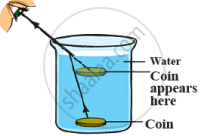
The coin disappears in a vessel as it is seen from a specific location. But as soon as the water is poured into the vessel to a certain level, the coin appears.
Write a scientific reason.
The coin in the disappeared to have been seen from a specific location. But as soon as the water is poured into the pot to a certain level, the coin appears.
Advertisements
उत्तर
- Light rays coming from the coin emerge out of water and change their direction due to the refraction of light.
- Hence, as soon as the water is poured into the pot to a certain level, the coin appears.
APPEARS IN
संबंधित प्रश्न
What is refraction of light?
Fill in the following blank with a suitable word:
When light is reflected, the angles of incidence and reflection are ............ .
Where is the image when you look at something in a mirror?
What are the important differences between looking at a photograph of your face and looking at yourself in a plane mirror?
State the uses of plane mirrors.
What is meant by 'reflection of light'?
State and explain the laws of reflection of light at a plane surface (like a plane mirror), With the help of a labelled ray-diagram. Mark the angles of 'incidence' and 'reflection' clearly on the diagram. If the angle of reflection is 47.5°, what will be the angle of incidence?
An object is placed 20 cm in front of a plane mirror. The mirror is moved 2 cm towards the object. The distance between the positions of the positions of the original and final images seen in the mirror is ______.
A man sits in an optician's chair looking into plane mirror which is 2 m away from him and views the image of a chart which faces the mirror and is 50 cm behind his head. How far away from his eyes does the chart appear to be?
Name the phenomenon due to which a swimming pool appears less deep than it really is.
In which material do you think light rays travel faster-glass or air?
Light travelling from a denser medium to a rarer medium along a normal to the boundary:
(a) is refracted towards the normal
(b) is refracted away from the normal
(c) goes along the boundary
(d) is not refracted
Water is optically denser than glass.
A ray of light when passes from glass to air, bends towards the normal.
The depth of a pond when seen from above appears to be less.
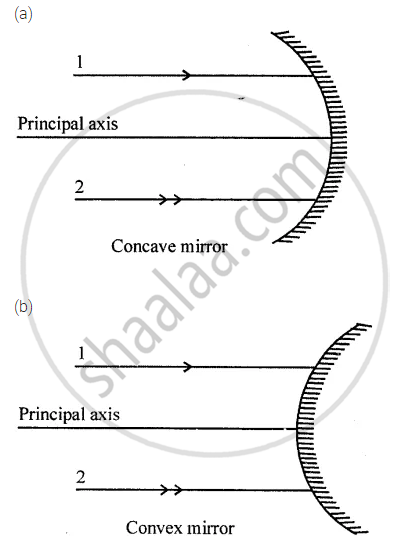
Draw suitable diagrams to illustrate how a beam of light incident parallel to the principal axis is reflected by:
(a) a concave mirror, and (b) a convex mirror
The diagram (figure) given below shows two parallel rays 1 and 2 incident on (a) a concave mirror, (b) a convex mirror. Draw the reflected rays and mark the focus by the symbol F.
We can see the sun even when it is little below the horizon because of ______.
Choose and write the correct option.
If we gradually increase the angle of incidence of a ray of light passing through prism then …..
Define the principal focus of a concave mirror.
What is atmospheric reflection? Explain with the help of a labelled diagram that the position of a star as seen by us is not its true position.
Write scientific reason.
The bottom of a pond appears raised.
Observe the given figure and write appropriate phenomenon of light in the box.

The angle of incidence from air to glass at the point O on the hemispherical glass slab is.
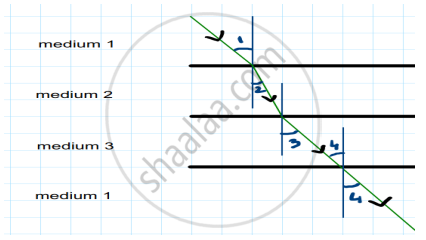
In the above diagram light is travelling through different media. It is noted by a scientist that ∠1= ∠3 = ∠4 but ∠2 < ∠1. Which of the following statement would be correct?
A water tank appears shallower when it is viewed from the top due to refraction.
Twinkling of stars and Mirage are the two phenomena occurring due to refraction.
Under what circumstances there won’t be any refraction of light when it enters from one medium to another?
Match the following:
| Column I | Column II | ||
| 1. | r > 90 | a. | Light gazes at the surface of separation between the two modes. |
| 2. | r = 90 | b. | No refraction. |
| 3. | r < 90 | c. | Refracted ray away from the normal |
The bottom of swimming pool appears to be less deep than the actual one because of
A normal is an imaginary line drawn ________ to the boundary at the point of incidence.
When light passes from one transparent medium to another, its direction changes due to:
When light travels from a rarer medium to a denser medium, its speed:
When light travels from a denser medium to a rarer medium, its speed:
The absolute refractive index of a medium is given by:
