Advertisements
Advertisements
प्रश्न
We can see the sun even when it is little below the horizon because of ______.
विकल्प
Reflection of light
Refraction of light
Dispersion of light
Absorption of light
Advertisements
उत्तर
We can see the Sun even when it is little below the horizon because of refraction of light.
Explanation:
We can see the Sun even when it is a little below the horizon because of atmospheric refraction. The Earth’s atmosphere bends the light from the Sun upwards towards the eye of the observer. Even though the Sun itself might be just below the horizon line, the light is refracted or bent by the atmosphere, thus making the Sun appear to be visible.
संबंधित प्रश्न
Which property of light makes a pencil cast a shadow when it is held in front of a light source?
State whether the following statement is true of false:
A student says that we can see an object because light from our eyes is reflected back by the object.
Which type of reflection of light leads to the formation of images?
State the uses of plane mirrors.
The angle of reflection is equal to the angle of incidence:
(a) always
(b) sometimes
(c) under special conditions
(d) never
The image formed by a plane mirror is :
(a) virtual, behind the mirror and enlarged.
(b) virtual, behind the mirror and of the same size as the object.
(c) real, at the surface of the mirror and enlarged.
(d) real, behind the mirror and of the same size as the object.
Explain how to read the following message which was found on some blotting paper:

State two effects caused by the refraction of light.
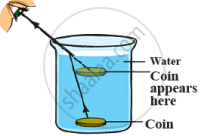
Name the phenomenon due to which a swimming pool appears less deep than it really is.
When a ray of light passes from air into glass, is the angle of refraction greater than or less than the angle of incidence?
In which material do you think light rays travel faster-glass or air?
Why does a ray of light bend when it travels from one medium to another?
Fill in the following blank with suitable word:
Light travelling along a normal is ...............refracted.
Fill in the following blank with suitable word:
Light bends when is passes from water into air. We say that it is ............
What is meant by ‘refraction of light’?
When a light ray passes from air into glass, what happens to its speed? Draw a diagram to show which way the ray of light bends.
With the help of a labelled diagram, explain why a tank full of water appears less deep than it actually is.
Show the lateral displacement of the ray on the diagram.
Explain with the help of a labelled ray diagram, why a pencil partly immersed in water appears to be bent at the water surface. State whether the bending of pencil will increase or decrease if water is replaced by another liquid which is optically more dense than water. Give reason for your answer.
A ray of light passes from a medium X to another medium Y. No refraction of light occurs if the ray of light hits the boundary of medium Y at an angle of:
(a) 0°
(b) 45°
(c) 90°
(d) 120°
A vertical ray of light strikes the horizontal surface of some water:
- What is the angle of incidence?
- What is the angle of refraction?
The phenomenon of change in the direction of light when it passes from one transparent medium to another is called ___________.
Explain how the formation of a rainbow occurs.
Lights of different colours are used as signal for safety transport. From these, the wavelength of red light is _______ nm.
Observe the given figure and write appropriate phenomenon of light in the box.
State whether true or false. If false, correct the statement.
The angle of deviation depends on the refractive index of the glass.
What is refractive index?
You are given water, mustard oil, glycerine and kerosene. In which of these media a ray of light incident obliquely at same angle would bend the most?
Noor, a young student, was trying to demonstrate some properties of light in her Science project work. She kept ‘X’ inside the box (as shown in the figure) and with the help of a laser pointer made light rays pass through the holes on one side of the box. She had a small butter-paper screen to see the spots of light being cast as they emerged.

Her friend noted the following observations from this demonstration:
- Glass is optically rarer than air.
- Air and glass allow light to pass through them with the same velocity.
- Air is optically rarer than glass.
- Speed of light through a denser medium is faster than that of a rarer medium.
- The ratio: sin of angle of incidence in the first medium to the ratio of sin of angle of refraction in the second medium, gives the refractive index of the second material with respect to the first one.
Which one of the combinations of the above statements given below is correct.
When light passes from one medium to another the ray gets bent. This property of light is called ______.
The ratio of the sine of the angle of incidence to the sine of ______ is constant.
Light is refracted or bent while going from one medium to another because of its ______ changes.
A water tank appears shallower when it is viewed from the top due to refraction.
In refraction of light through a glass slab, the directions of the incident ray and the refracted ray are ______.
