Advertisements
Advertisements
प्रश्न
A ray of light strikes a plane mirror such that its angle of incidence is 30°. What angle does the reflected ray make with the mirror surface?
Advertisements
उत्तर
The reflected ray makes an angle of 60o with the mirror surface because:
angle of incidence = angle of reflection = 30o, and
angle of the reflected ray with the mirror surface = 90o - angle of reflection = 90o - 30o = 60o
APPEARS IN
संबंधित प्रश्न
With the help of a labelled ray-diagram, describe how a plane mirror forms an image of a point source of light placed in front of it. State the characteristics of the image formed in a plane mirror.
A man stands 10 m in front of a large plane mirror. How far must the walk before he is 5 m away from his image?
A man sits in an optician's chair looking into plane mirror which is 2 m away from him and views the image of a chart which faces the mirror and is 50 cm behind his head. How far away from his eyes does the chart appear to be?
A ray of light goes from water into air. Will it bend towards the normal or away from the normal?
When a ray of light passes from air into glass, is the angle of refraction greater than or less than the angle of incidence?
When a light ray passes from air into glass, what happens to its speed? Draw a diagram to show which way the ray of light bends.
Draw suitable diagrams to illustrate how a beam of light incident parallel to the principal axis is reflected by:
(a) a concave mirror, and (b) a convex mirror
A small air bubble in a glass block when seen from above appears to be raised because of ______.
The speed of light varies in different media.
Observe the given figure and name the following.
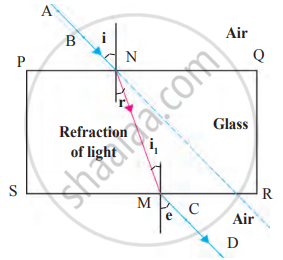
| Ray AB | |
| Ray NM | |
| Ray MD | |
| ∠ r |
Numerical problems.
The speed of light in water is 2.25 × 10⁸ ms–1. If the speed of light in vacuum is 3 × 10⁸ ms–1, calculate the refractive index of water.
The refractive index of a transparent medium is always greater than ______.
A pencil when dipped in water in a glass tumbler appears to be bent at the interface of air and water. Will the pencil appear to be bent to the same extent, if instead of water we use liquids like, kerosene or turpentine. Support your answer with reason.
Which object use the reflection of light?
How do twinkling stars occur? (or) what is the cause of the twinkling of stars?
A ray of light starting from diamond is incident on the interface separating diamond and water. Draw a labelled ray diagram to show. the refraction of light in this case.
The absolute refractive index of a medium is given by:
A medium with a higher refractive index is:
