Advertisements
Advertisements
प्रश्न
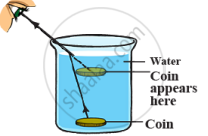
Observe the given figure and write appropriate phenomenon of light in the box.
Advertisements
उत्तर
Refraction of light
APPEARS IN
संबंधित प्रश्न
Name the phenomenon responsible for the following effect:
When we sit in front of a plane mirror and write with our right hand, it appears in the mirror that we are writing with the left hand.
A ray of light strikes a plane mirror such that its angle of incidence is 30°. What angle does the reflected ray make with the mirror surface?
What is lateral inversion? Explain by giving a suitable example.
What is the difference between regular reflection of light and diffuse reflection of light?
Explain why, though both a plane mirror and a sheet of paper reflect light but we can see the image of our face in a plane mirror but not in a sheet of paper.
The image in a plane mirror is virtual and laterally inverted. What does this statement mean?
The image of an object formed by a plane mirror is:
(a) virtual
(b) real
(c) diminished
(d) upside-down
A man stands 10 m in front of a large plane mirror. How far must the walk before he is 5 m away from his image?
A man sits in an optician's chair looking into plane mirror which is 2 m away from him and views the image of a chart which faces the mirror and is 50 cm behind his head. How far away from his eyes does the chart appear to be?
Explain how to read the following message which was found on some blotting paper:

If a ray of light goes form a denser medium to a rarer medium, will it bend towards the normal or away from the normal?
Fill in the following blank with suitable word:
Light bends when is passes from water into air. We say that it is ............
What is meant by ‘refraction of light’?
Name the phenomenon due to which a pencil partly immersed in water and held obliquely appears to be bent at the water surface.
- With the help of a diagram, show how when light falls obliquely on the side of a rectangular glass slab, the emergent ray is parallel to the incident ray.
- Show the lateral displacement of the ray on the diagram.
Show the lateral displacement of the ray on the diagram.
Light travelling from a denser medium to a rarer medium along a normal to the boundary:
(a) is refracted towards the normal
(b) is refracted away from the normal
(c) goes along the boundary
(d) is not refracted
Water is optically denser than glass.
Light travels at a lower speed in water than in air.
Water is optically .......... than air.
When a ray of light travels from water to air, it bends ............. the normal.
When a ray of light travels from air to glass, it bends .......... the normal.
What do you understand by refraction of light?
A small air bubble in a glass block when seen from above appears to be raised because of ______.
Light enters from air to glass having refractive index 1.50. What is the speed of light in the glass? The speed of light in vacuum is 3 × 10⁸ m s−1.
Write scientific reason.
A pencil appears to be broken near the surface of water.
Explain with diagrams how refraction of incident light takes place from
- rarer to denser medium
- denser to rarer medium
- normal to the surface separating the two media.
You are given water, mustard oil, glycerine and kerosene. In which of these media a ray of light incident obliquely at same angle would bend the most?
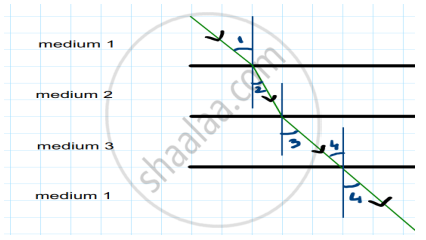
In the above diagram light is travelling through different media. It is noted by a scientist that ∠1= ∠3 = ∠4 but ∠2 < ∠1. Which of the following statement would be correct?
Noor, a young student, was trying to demonstrate some properties of light in her Science project work. She kept ‘X’ inside the box (as shown in the figure) and with the help of a laser pointer made light rays pass through the holes on one side of the box. She had a small butter-paper screen to see the spots of light being cast as they emerged.

Her friend noted the following observations from this demonstration:
- Glass is optically rarer than air.
- Air and glass allow light to pass through them with the same velocity.
- Air is optically rarer than glass.
- Speed of light through a denser medium is faster than that of a rarer medium.
- The ratio: sin of angle of incidence in the first medium to the ratio of sin of angle of refraction in the second medium, gives the refractive index of the second material with respect to the first one.
Which one of the combinations of the above statements given below is correct.
Light bends as it passes from one medium to another. What is this phenomenon called?
Which is optically denser out of the two medium M1& M2 having the refractive indices = 1.71 and 1.36 respectively?
Match the following:
| Column I | Column II | ||
| 1. | r > 90 | a. | Light gazes at the surface of separation between the two modes. |
| 2. | r = 90 | b. | No refraction. |
| 3. | r < 90 | c. | Refracted ray away from the normal |
When a ray of light travels normal to the given surface, then the angle of refraction is ______.
The ray that enters the second medium after crossing the boundary is called the:
The constant \[\frac{\sin i}{\sin r}\] for a given pair of media is called the:
A larger refractive index of a medium means that light travels:
