Advertisements
Advertisements
Question
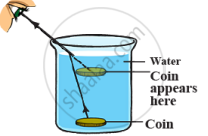
Observe the given figure and write appropriate phenomenon of light in the box.
Advertisements
Solution
Refraction of light
APPEARS IN
RELATED QUESTIONS
| Column I | Column II | Column III | |
| 1 | Dispersion | Long-sightedness | Twinkling of stars |
| 2 | Refraction | Splitting of white light into component colours | Convex lens |
| 3 | Hypermetropia | Change in the direction of the ray of light due to change in medium | Spectrum of seven colours |
State whether the following statement is true of false:
A student says that we can see an object because light from our eyes is reflected back by the object.
What is lateral inversion? Explain by giving a suitable example.
An extended object in the form of an arrow pointing upward has been placed in front of a plane mirror. Draw a labelled ray-diagram to show the formation of its image.
The image of an object formed by a plane mirror is:
(a) virtual
(b) real
(c) diminished
(d) upside-down
An object is placed 20 cm in front of a plane mirror. The mirror is moved 2 cm towards the object. The distance between the positions of the positions of the original and final images seen in the mirror is ______.
If a ray of light goes from a rarer medium to a denser medium, will it bend towards the normal or away from it?
A ray of light travelling in glass emerges into air. State whether it will bend towards the normal or away from the normal.
When a ray of light passes from air into glass, is the angle of refraction greater than or less than the angle of incidence?
In which material do you think light rays travel faster-glass or air?
A ray of light travelling in air is incident on a rectangular glass block and emerges out into the air from the opposite face. Draw a labelled ray diagram to show the completer path of this ray of light. Mark the two points where the refraction of light takes place. What can you say about the final direction of ray of light?
Light travels more quickly through water than through glass.
If a ray of light passes from glass into water, which way will it bend : towards the normal or away from the normal?
When a light ray passes from air into glass, what happens to its speed? Draw a diagram to show which way the ray of light bends.
A vertical ray of light strikes the horizontal surface of some water:
What is the angle of refraction?
A ray of light when passes from glass to air, bends towards the normal.
Light travels at a lower speed in water than in air.
When a ray of light travels from water to air, it bends ............. the normal.
When a ray of light travels from air to glass, it bends .......... the normal.
A light ray suffers reflection and refraction at the boundary in passing from air to water. Draw a neat labelled ray diagram to show it.
List four characteristics of the image formed by a concave lens of focal length 20 cm when the object is placed at a distance of 40 cm from its optical centre.
The size of image of an object by a convex lens of focal length 20 cm is observed to be reduced to `1/3` rd of its size . Find the distance of the object from the optical centre of the lens .
The laws of reflection hold true for ______.
Due to _______ pencil looks bent in water, in the given experiment.
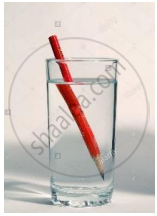
Light changes its direction when going from one transparent medium to another transparent medium. This is called _______.
Right or wrong sentence.
The incident rays and refracted rays are on opposite sides of the column.
Write scientific reason.
A pencil appears to be broken near the surface of water.
Why does a ray of light bend when it travels from one medium to another?
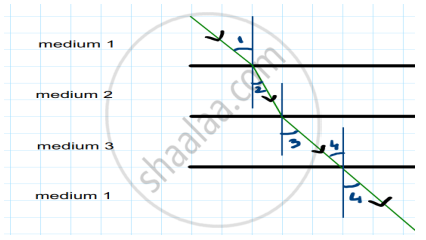
In the above diagram light is travelling through different media. It is noted by a scientist that ∠1= ∠3 = ∠4 but ∠2 < ∠1. Which of the following statement would be correct?
A pencil when dipped in water in a glass tumbler appears to be bent at the interface of air and water. Will the pencil appear to be bent to the same extent, if instead of water we use liquids like, kerosene or turpentine. Support your answer with reason.
The phenomenon of light passing through the object is called ______.
How does the light travel?
The ratio of the sine of the angle of incidence to the sine of ______ is constant.
Which is optically denser out of the two medium M1& M2 having the refractive indices = 1.71 and 1.36 respectively?
When a light ray passes from a denser medium to a rarer medium, it bends:
When light travels from a denser medium to a rarer medium, its speed:
In the formula for absolute refractive index \[n = \frac{c}{v}\], the quantity c represents:
