Advertisements
Advertisements
Question
What do you understand by refraction of light?
Advertisements
Solution 1
The change in the direction of the path of light, when it passes from one transparent medium to another transparent medium, is called refraction of light.
Solution 2
In essence, the refraction of light is a surface phenomenon. "When a ray of light travels from one optical medium to another, it changes the direction of the path of light, and this is called the refraction of light."
RELATED QUESTIONS
If an object is placed at a distance of 10 cm in from of a plane mirror, how far would it be from its image?
A ray of light strikes a plane mirror such that its angle of incidence is 30°. What angle does the reflected ray make with the mirror surface?
A boy with a mouth 5 cm wide stands 2 m away from a plane mirror. Where is his image and how wide is the image of his mouth?
The image formed by a plane mirror is :
(a) virtual, behind the mirror and enlarged.
(b) virtual, behind the mirror and of the same size as the object.
(c) real, at the surface of the mirror and enlarged.
(d) real, behind the mirror and of the same size as the object.
Name the phenomenon due to which a swimming pool appears less deep than it really is.
Fill in the following blank with suitable word:
Light bends when is passes from water into air. We say that it is ............
Water is optically denser than glass.
Match the Following
| Column A | Column B |
| (a) white Light | (1) Convex mirror |
| (b) Refraction | (2) Concave mirror |
| (c) Virtual images | (3) refraction |
| (d) Real images | (4) spectrum |
| (e) Prism | (5) ray of light from glass to air |
A small air bubble in a glass block when seen from above appears to be raised because of ______.
Define the principal focus of a concave mirror.
Light enters from air to glass having refractive index 1.50. What is the speed of light in the glass? The speed of light in vacuum is 3 × 10⁸ m s−1.
A real image is formed by the light rays after reflection or refraction when they:
- actually meet or intersect with each other.
- actually converge at a point.
- appear to meet when they are produced in the backward direction.
- appear to diverge from a point.
Which of the above statements are correct?
The refractive index of four substances A, B, C, and D are 1.31, 1.43, 1.33, 2.4 respectively. The speed of light is maximum in
What is refractive index?
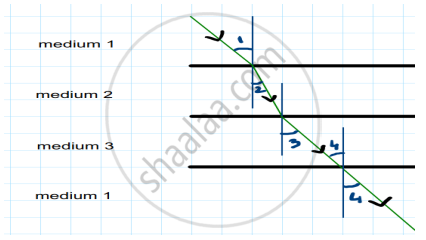
In the above diagram light is travelling through different media. It is noted by a scientist that ∠1= ∠3 = ∠4 but ∠2 < ∠1. Which of the following statement would be correct?
A star appears twinkling into the sky because of the reflection of light by the atmosphere.
In refraction of light through a glass slab, the directions of the incident ray and the refracted ray are ______.
A normal is an imaginary line drawn ________ to the boundary at the point of incidence.
