Advertisements
Advertisements
Question
Describe an experiment to show that a light ray bends when it passes from one transparent medium into another transparent medium.
Advertisements
Solution 1
EXPERIMENT: Spread and fix a sheet of white paper on the drawing board.
At the centre of the paper, place a glass slab XYX ‘Y’ and draw its boundary.
A ray of light AB travelling from air (rarer medium) to glass slab (denser medium). Part of path BC in denser medium bends towards the normal.
∠r ∠i. This shows that when light travels from RARER to DENSER medium bends towards the normal. Ray BC travels from DENSER medium to RARER medium in air (RAY CD) bend away from normal. ∠e >∠r.
This shows that when a ray of light travels from DENSER to RARER medium bends AWAY from normal.
Solution 2
To demonstrate that a light ray bends (refracts) when it passes from one transparent medium into another.
Procedure:
-
Set Up the Experiment: Place the white paper on a flat surface. Put the glass slab on the paper and trace its outline with a pencil.
-
Draw the Incident Ray: Draw a straight line approaching one side of the glass slab at an angle (not perpendicular). Mark the point where the incident ray meets the glass slab as A.
-
Shine the Light: Direct the laser pointer or ray box along the incident ray towards A.
-
Observe the Refracted Ray: On the other side of the glass slab, observe the path of the light as it emerges. Mark the exit point as B.
-
Trace the Path: Remove the glass slab and use a ruler to draw the refracted ray inside the slab and the emergent ray outside.
-
Measure Angles: Measure the angle of incidence (i) and the angle of refraction (r) at point A.

APPEARS IN
RELATED QUESTIONS
A ray of light falls normally on a glass slab. What is the angle of incidence?
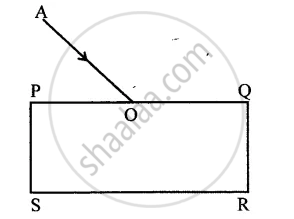
The diagram in figure shows a ray of light AO falling on a rectangular glass slab PQRS. Complete the diagram till the ray of light emerges out of the slab. Label on the diagram the incident ray, the refracted ray and the emergent ray.
What is mirage? Give a reason for its formation?
State the changes in the position, size and nature of the image when the object is brought from infinity up to the convex lens. Illustrate your answer by drawing ray diagrams.
A person is looking at the image of a tree in a mirror placed 3.5 m in front of him. Given that the tree is at 0.5 m behind his eyes. Find the distance between the image of the tree and his eyes. What are needed to see an object?
A boy of height 1m 45 cm is standing in front of a long mirror at a distance of 2 m. From this information, fill up the following sentences:
- The distance between the boy and his image is ______
- The height of the image is______
- When the boy moves 1m forward, the distance between her and her image is______
Draw a diagram of a pin hole camera showing the rays of light passing between the Object and its image
Assertion (A): Virtual objects can’t be seen by the human eye.
Reason (R): Virtual image is formed by converging rays.
Write the difference between real images and virtual images.
The image formed by a plane mirror is ______.
