Advertisements
Advertisements
प्रश्न
What do you understand by refraction of light?
Advertisements
उत्तर १
The change in the direction of the path of light, when it passes from one transparent medium to another transparent medium, is called refraction of light.
उत्तर २
In essence, the refraction of light is a surface phenomenon. "When a ray of light travels from one optical medium to another, it changes the direction of the path of light, and this is called the refraction of light."
संबंधित प्रश्न
| Column I | Column II | Column III | |
| 1 | Dispersion | Long-sightedness | Twinkling of stars |
| 2 | Refraction | Splitting of white light into component colours | Convex lens |
| 3 | Hypermetropia | Change in the direction of the ray of light due to change in medium | Spectrum of seven colours |
Where is the image when you look at something in a mirror?
Explain why, though both a plane mirror and a sheet of paper reflect light but we can see the image of our face in a plane mirror but not in a sheet of paper.
A man stands 10 m in front of a large plane mirror. How far must the walk before he is 5 m away from his image?
A man sits in an optician's chair looking into plane mirror which is 2 m away from him and views the image of a chart which faces the mirror and is 50 cm behind his head. How far away from his eyes does the chart appear to be?
A ray of light strikes a plane mirror PQ at an angle of incidence of 30°, is reflected from the plane mirror and then strikes a second plane mirror QR placed at right angles to the first mirror. The angle of reflection at the second mirror is ______.
A ray of light passes from air into a block of glass. Does it bend towards the normal or away from it?
Which phenomenon of light makes the water to appear shallower than it really is?
A vertical ray of light strikes the horizontal surface of some water:
What is the angle of refraction?
Water is optically denser than glass.
Water is optically .......... than air.
Fill in the blank and Explain the completed sentences.
The change in ______ of light rays while going from one medium to another is called refraction.
Due to _______ pencil looks bent in water, in the given experiment.
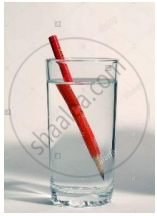
Write scientific reason.
A pencil appears to be broken near the surface of water.
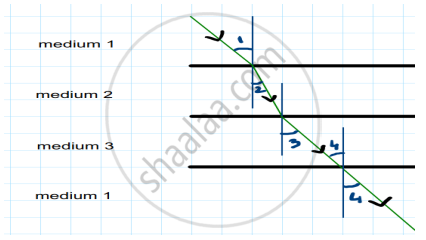
In the above diagram light is travelling through different media. It is noted by a scientist that ∠1= ∠3 = ∠4 but ∠2 < ∠1. Which of the following statement would be correct?
Which object use the reflection of light?
Why a pencil partly immersed in water appears to be bent at the water surface.
The bottom of swimming pool appears to be less deep than the actual one because of
The constant \[\frac{\sin i}{\sin r}\] for a given pair of media is called the:
