Advertisements
Advertisements
Question
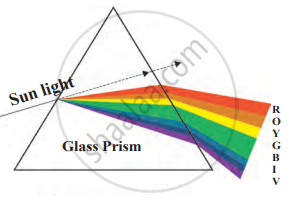
Observe the given figure and write appropriate phenomenon of light in the box.
Advertisements
Solution
Dispersion of light
APPEARS IN
RELATED QUESTIONS
What happens when a ray of ordinary light is passed through a triangular glass prism?
Describe how you could demonstrate that white light is composed of a number of colours.
The splitting up of white light into seven colours on passing through a glass prism is called ______.
When white light passes through a prism, it ............
A ray of light moving from an optically rarer to a denser medium
A ray of white light falls on a prism. Draw a ray diagram to show that the prism disperses the white light.
Explain the cause of dispersion of white light through a prism.
In which of the following four diagrams is the correct path of a ray of light passing through a glass prism shown ?
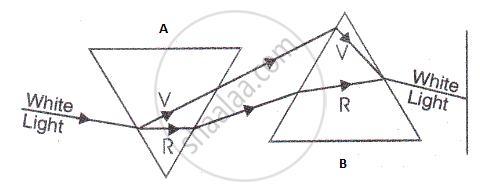
Complete the ray diagram given below to show the nature of light produced on the screen.
The completed ray diagram is as shown below:
A student has to trace the path of a ray of light through a glass prism. List four precautions he should observe for better results.
Write the range of wavelength of the infrared spectrum.
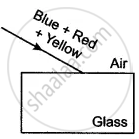
In the figure, a beam of light consisting of three colours blue, red, and yellow is incident on a prism and on a rectangular glass block respectively. Complete the diagram by drawings of the refracted and emergent rays.
Write an Explanation.
Critical angle
The phenomena of light involved in the formation of rainbow are ______.
In dispersion, the color of light that will bend more is ______.
What is a rainbow?
State True or False:
"Wavelength of red light is close to 700 nm.”
When sunlight passes through water droplets in the atmosphere it gets dispersed into its constituent colours forming a rainbow. A similar phenomenon is observed when white light passes through a prism.
Which colour will show the maximum angle of deviation and which colour will show the minimum angle of deviation?
Make a rainbow
Try to make your own rainbow. You can try this project in the morning or in the evening. Stand with your back towards the Sun. Take a hosepipe or a water pipe used in the garden. Make a fine spray in front of you. You can see different colours of rainbow in the spray.
