Advertisements
Advertisements
Question
The splitting up of white light into seven colours on passing through a glass prism is called ______.
Options
refraction
deflection
dispersion
scattering
reflection
Advertisements
Solution
The splitting up of white light into seven colours on passing through a glass prism is called dispersion.
RELATED QUESTIONS
In the following ray diagram the correctly marked angle are:

(a) ∠i and ∠e
(b) ∠A and ∠D
(c) ∠i, ∠e and ∠D
(d) ∠r, ∠A and ∠D
After tracing the path of a ray of light through a glass prism a student marked the angle of incidence (∠i), angle of refraction (∠r) angle of emergence (∠e) and the angle of deviation (∠D) as shown in the diagram. The correctly marked angles are :

(A) ∠i and ∠r
(B) ∠i and ∠e
(C) ∠i, ∠e and ∠D
(D) ∠i, ∠r and ∠e
In the following diagram the correctly marked angles are :

(a) ∠A and ∠e
(b) ∠i, ∠A and ∠D
(c) ∠A ∠r and ∠e
(b) ∠A ∠r and ∠D
Draw a ray diagram to show the dispersion of white light.
When a beam of white light is passed through a prism, it splits to form lights of seven colours. Is it possible to recombine the lights of seven colours to obtain the white light again? Explain your answer.
Draw a diagram to show the refraction of light through a glass prism. On this diagram, mark
(i) incident ray
(ii) emergent ray, and
(iii) angle of deviation.
What is a rainbow?
What acts as tiny prisms in the formation of a rainbow?
Name the process which is involved in the formation of a rainbow.
A beam of white light is shone onto a glass prism. The light cannot be:
(a) deviated
(b) dispersed
(c) focused
(d) refracted
When white light passes through a prism, it ............
State the speed of light in (a) air, (b) water, and (c) glass
How does the speed of light determine the optical density of a medium?
You are given a disc divided into seven sectors with colours violet, indigo, blue, green, yellow, orange and red in them. What would be its colour when it is rotated rapidly?
Complete the ray diagram given below to show the nature of light produced on the screen.
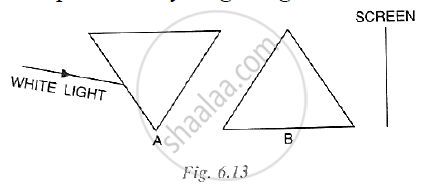
In an experiment to trace the path of a ray of light through a glass prism for different values of angle of incidence a student would find that the emergent ray:
(A) is parallel to the incident ray
(B) perpendicular to the incident ray
(C) is parallel to the refracted ray
(D) bends at an angle to the direction of incident ray
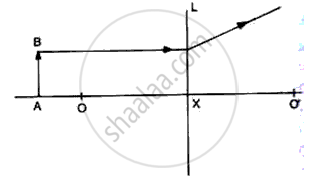
Refer to fig
(i) Name the lens L.
(ii) What are the points O, O' called?
(iii) Complete the diagram to form the image of the object AB.
(iv) Write three characteristics of the image.
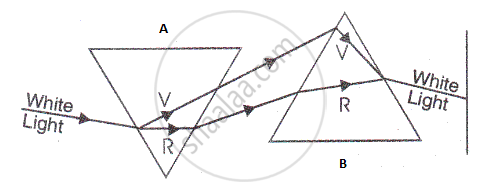
Complete the ray diagram given below to show the nature of light produced on the screen.
The completed ray diagram is as shown below:
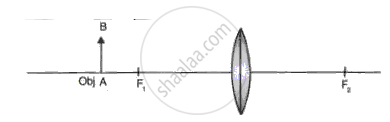
An object AB is placed in front of a convex lens as shown in fig. 4. Complete the ray diagram and obtain the image formed and state the nature of the image.
Which characteristic property of light is responsible for the blue colour of the sky?
How can the presence of ultraviolet radiation be detected?
Write the range of wavelength of the ultraviolet spectrum.
Sunlight entering through a narrow aperture falls on a prism. Draw a neat labelled ray diagram to show the formation of the spectrum on a screen. Name the colour obtained nearer the base of the prism.
In the figure, a beam of light consisting of three colours blue, red, and yellow is incident on a prism and on a rectangular glass block respectively. Complete the diagram by drawings of the refracted and emergent rays.
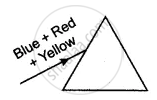
The splitting of white light into its component colours is called ____________.
Why do we see a rainbow in the sky only after rainfall?
The angle of deviation through a prism is minimum when

- Incident rays and emergent rays are symmetric to the prism.
- The refracted ray inside the prism becomes parallel to its base.
- The angle of incidence is equal to that of the angle of emergence.
- When the angle of emergence has doubled the angle of incidence.
Choose the correct answer from the options given below:
In the following diagram showing dispersion of white light by a glass prism, the colours 'P' and 'Q’ respectively are:

When sunlight passes through water droplets in the atmosphere it gets dispersed into its constituent colours forming a rainbow. A similar phenomenon is observed when white light passes through a prism.
Instead of sunlight, a green-coloured ray is passed through a glass prism. What will be the colour of the emergent ray?
