Advertisements
Advertisements
Question
You are given a disc divided into seven sectors with colours violet, indigo, blue, green, yellow, orange and red in them. What would be its colour when it is rotated rapidly?
Advertisements
Solution

Newton’s colour disc— It is a circular disc taken by Newton to demonstrate that the recombination of seven colours produces white light. A circular cardboard disc which is divided into seven sectors and they were painted with the seven colours of VIBGYOR. The disc when rotated at a very high speed appears WHITE.
APPEARS IN
RELATED QUESTIONS
A student traces the path of a ray of light through a triangular glass prism for different values of angle of incidence. On analyzing the ray diagrams, which one of the following conclusions is he likely to draw?
(A) The emergent ray is parallel to the incident ray.
(B) The emergent ray bends at an angle to the direction of the incident ray.
(C) The emergent ray and the refracted ray are at right angles to each other.
(D) The emergent ray is perpendicular to the incident ray.
Draw a ray diagram to explain the term angle of deviation.
Name the process which is involved in the formation of a rainbow.
The property of splitting of white light into its seven constituent colours is known as
Explain briefly, with the help of a neat labelled diagram, how white light gets dispersed by a prism. On which surface of a prism, there is both dispersion and deviation of light, and on which surface of the prism, there is only deviation of light ?
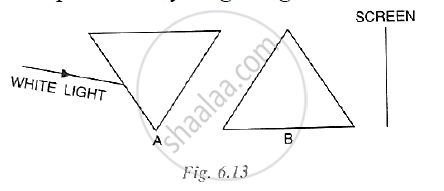
Complete the ray diagram given below to show the nature of light produced on the screen.
In the spectrum of white light by a prism, the colour at the extreme end opposite to the base of prism is ______.
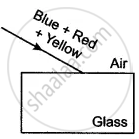
In the figure, a beam of light consisting of three colours blue, red, and yellow is incident on a prism and on a rectangular glass block respectively. Complete the diagram by drawings of the refracted and emergent rays.
The periscope is an optical device with a polished surface that reflects the light falling on it.
Assertion: We can see the rainbow in the sky when the rain starts falling after a spell of bright sunlight.
Reason: The rainbow is formed due to the dispersion of light.
