Advertisements
Advertisements
प्रश्न
You are given a disc divided into seven sectors with colours violet, indigo, blue, green, yellow, orange and red in them. What would be its colour when it is rotated rapidly?
Advertisements
उत्तर

Newton’s colour disc— It is a circular disc taken by Newton to demonstrate that the recombination of seven colours produces white light. A circular cardboard disc which is divided into seven sectors and they were painted with the seven colours of VIBGYOR. The disc when rotated at a very high speed appears WHITE.
APPEARS IN
संबंधित प्रश्न
Study the following diagrams in which the path of a ray of light passing through a glass prism as traced by four students P, Q, R and S is shown:

The student who has traced the path correctly is
(A) P
(B) Q
(C) R
(D) S
State the cause of dispersion of white light passing through a glass prism. How did Newton show that white light of sun contains seven colours using two identical glass prisms. Draw a ray diagram to show the path of light when two identical glass prisms are arranged together in inverted position with respect to each other and a narrow beam of white light is allowed to fall obliquely on one of the focus of the first prism.
As light rays pass from air into a glass prism, are they refracted towards or away from the normal?
A beam of white light is shone onto a glass prism. The light cannot be:
(a) deviated
(b) dispersed
(c) focused
(d) refracted
How does the speed of light determine the optical density of a medium?
In figure AO is the ray of white light falling on a prism PQR. Complete the diagram till the light emerges out from the prism and falls on the screen.
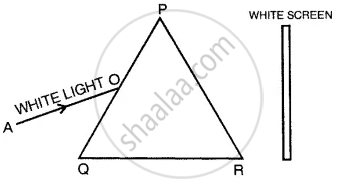
When we place a glass prism in the path of a narrow beam of white light a spectrum is obtained. What happens when a second identical prism is placed in an inverted position with respect to the first prism? Draw a labelled ray diagram to illustrate it.
Make the correct choice for each of the following:
Which one of the following Fig correctly shows the path of the ray through the glass block?
Name the scientist who was the first to use a glass prism to obtain the spectrum of sunlight.
The dispersive powers of flint glass and crown glass are 0.053 and 0.034, respectively and their mean refractive indices are 1.68 and 1.53 for white light. Calculate the angle of the flint glass prism required to form an achromatic combination with a crown glass prism of refracting angle 4°:
