Advertisements
Advertisements
प्रश्न
How does the speed of light determine the optical density of a medium?
Advertisements
उत्तर १
If the speed of light in a medium is less than the speed of light in air, means the MEDIUM is DENSER than air.
If the speed of light is more than the speed of light in AIR, means the MEDIUM is LESS DENSER than air.
Speed of light is 1/density of medium
उत्तर २
- Definition of Optical Density: Optical density refers to how much a medium can slow down the speed of light compared to its speed in a vacuum.
- Speed of Light in Different Media: Light travels fastest in a vacuum (c = 3 × 10⁸ m/s). When light enters a medium (like water, glass, or air), its speed decreases depending on the medium's optical density.
- Relation Between Speed and Optical Density: The greater the optical density, the slower the speed of light in the medium. For example, light travels more slowly in glass than in air because glass has a higher optical density.
- Refractive Index: The optical density is quantified using the refractive index (n), which is defined as: `n = c/v`
- Example:
- In air: n ≈ 1, light speed is almost the same as in a vacuum.
- In water: n ≈ 1.33, light slows down significantly.
- In glass: n ≈ 1.5, light slows down even more.
APPEARS IN
संबंधित प्रश्न
In the following diagram, the path of a ray of light passing through a glass prism is shown:
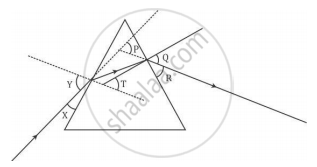
In this diagram the angle of incidence, the angle of emergence and the angle of deviation respectively are (select the correct option):
(A) X, R and T
(B) Y, Q and T
(C) X, Q and P
(D) Y, Q and P
After tracing the path of a ray of light through a glass prism a student marked the angle of incidence (∠i), angle of refraction (∠r) angle of emergence (∠e) and the angle of deviation (∠D) as shown in the diagram. The correctly marked angles are :

(A) ∠i and ∠r
(B) ∠i and ∠e
(C) ∠i, ∠e and ∠D
(D) ∠i, ∠r and ∠e
Draw a diagram to show how white light can be dispersed into a spectrum by using a glass prism. Mark the various colours of the spectrum.
The colour of white light which is deviated the maximum on passing through the glass prism is:
(a) blue
(b) indigo
(c) red
(d) orange
The wavelengths of violet and red light are 4000 Å and 8000 Å respectively. Which of the two has the higher frequency?
State two properties of ultraviolet radiation which differ from visible light.
The process of separation of light into its component colours while passing through a medium is called _______.
Observe the given figure and write appropriate phenomenon of light in the box.
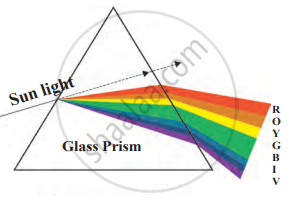
State the colour which bends:
- The most.
- The least while passing through a glass prism.
When sunlight passes through water droplets in the atmosphere it gets dispersed into its constituent colours forming a rainbow. A similar phenomenon is observed when white light passes through a prism.
Which colour will show the maximum angle of deviation and which colour will show the minimum angle of deviation?
