Advertisements
Advertisements
प्रश्न
How does the speed of light determine the optical density of a medium?
Advertisements
उत्तर १
If the speed of light in a medium is less than the speed of light in air, means the MEDIUM is DENSER than air.
If the speed of light is more than the speed of light in AIR, means the MEDIUM is LESS DENSER than air.
Speed of light is 1/density of medium
उत्तर २
- Definition of Optical Density: Optical density refers to how much a medium can slow down the speed of light compared to its speed in a vacuum.
- Speed of Light in Different Media: Light travels fastest in a vacuum (c = 3 × 10⁸ m/s). When light enters a medium (like water, glass, or air), its speed decreases depending on the medium's optical density.
- Relation Between Speed and Optical Density: The greater the optical density, the slower the speed of light in the medium. For example, light travels more slowly in glass than in air because glass has a higher optical density.
- Refractive Index: The optical density is quantified using the refractive index (n), which is defined as: `n = c/v`
- Example:
- In air: n ≈ 1, light speed is almost the same as in a vacuum.
- In water: n ≈ 1.33, light slows down significantly.
- In glass: n ≈ 1.5, light slows down even more.
APPEARS IN
संबंधित प्रश्न
As light rays pass from air into a glass prism, are they refracted towards or away from the normal?
A beam of white light is shone onto a glass prism. The light cannot be:
(a) deviated
(b) dispersed
(c) focused
(d) refracted
The splitting up of white light into seven colours on passing through a glass prism is called ______.
The coloured light having the maximum speed in glass prism is ______.
When white light passes through a prism, it ............
A ray of white light is passed through a glass prism and a spectrum is obtained on a screen.
- Name the seven colours of the spectrum in order.
- Do the colours have the same width in the spectrum?
- Which of the colour of the spectrum of white light deviates (i) the most, (ii) the least?
In the spectrum of white light by a prism, the colour at the extreme end opposite to the base of prism is ______.
An object is placed in front of a converging lens and in front of a diverging lens as in fig.
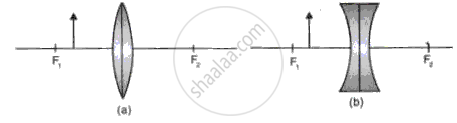
(a)Complete the ray diagram to obtain an image.
(b)Compare the nature of image formed by both the lenses in the above case.
The periscope is an optical device with a polished surface that reflects the light falling on it.
