Advertisements
Advertisements
Question
How does the speed of light determine the optical density of a medium?
Advertisements
Solution 1
If the speed of light in a medium is less than the speed of light in air, means the MEDIUM is DENSER than air.
If the speed of light is more than the speed of light in AIR, means the MEDIUM is LESS DENSER than air.
Speed of light is 1/density of medium
Solution 2
- Definition of Optical Density: Optical density refers to how much a medium can slow down the speed of light compared to its speed in a vacuum.
- Speed of Light in Different Media: Light travels fastest in a vacuum (c = 3 × 10⁸ m/s). When light enters a medium (like water, glass, or air), its speed decreases depending on the medium's optical density.
- Relation Between Speed and Optical Density: The greater the optical density, the slower the speed of light in the medium. For example, light travels more slowly in glass than in air because glass has a higher optical density.
- Refractive Index: The optical density is quantified using the refractive index (n), which is defined as: `n = c/v`
- Example:
- In air: n ≈ 1, light speed is almost the same as in a vacuum.
- In water: n ≈ 1.33, light slows down significantly.
- In glass: n ≈ 1.5, light slows down even more.
APPEARS IN
RELATED QUESTIONS
Describe an activity to show that colours of white light splitted by a glass prism can be recombined to get white light by another identical glass prism. Also draw ray diagram to show the recombination of the spectrum of white light.
Which of the following colour of white light is least deviated by the prism?
(a) green
(b) violet
(c) indigo
(d) yellow
The property of splitting of white light into its seven constituent colours is known as
When a white light ray falls on a prism, the ray at its first surface suffers ______.
Draw a labeled ray diagram to illustrate the dispersion of a narrow beam of white light when it passes through a glass prism.
If a monochromatic beam of light undergoes minimum deviation through an equiangular prism, how does the beam pass through the prism, with respect to its base?
An object is placed in front of a converging lens and in front of a diverging lens as in fig.
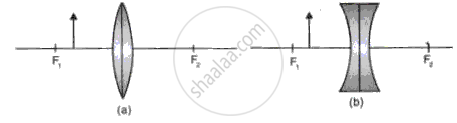
(a)Complete the ray diagram to obtain an image.
(b)Compare the nature of image formed by both the lenses in the above case.
The sunlight can be split into its constituent colors using ______.
Which one of the following is involved for the formation of rainbow in the sky?
The dispersive powers of flint glass and crown glass are 0.053 and 0.034, respectively and their mean refractive indices are 1.68 and 1.53 for white light. Calculate the angle of the flint glass prism required to form an achromatic combination with a crown glass prism of refracting angle 4°:
