Advertisements
Advertisements
Question
When a white light ray falls on a prism, the ray at its first surface suffers ______.
Options
No refraction
Only dispersion
Only deviation
Both deviation and dispersion
Advertisements
Solution
When a white light ray falls on a prism, the ray at its first surface suffers both deviation and dispersion.
APPEARS IN
RELATED QUESTIONS
Study the following diagrams in which the path of a ray of light passing through a glass prism as traced by four students P, Q, R and S is shown:

The student who has traced the path correctly is
(A) P
(B) Q
(C) R
(D) S
In the following diagram the correctly marked angles are :

(a) ∠A and ∠e
(b) ∠i, ∠A and ∠D
(c) ∠A ∠r and ∠e
(b) ∠A ∠r and ∠D
Which is refracted most by a prism : red light or violet light? Explain why?
Which of the following colour of white light is least deviated by the prism?
(a) green
(b) violet
(c) indigo
(d) yellow
Out of the following, the colour of light having the maximum wavelength is:
(a) violet
(b) indigo
(c) green
(d) orange
What do you understand by the term spectrum?
State two properties of ultraviolet radiation which differ from visible light.
Observe the given figure and write appropriate phenomenon of light in the box.
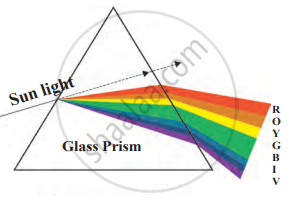
Observe the given diagram and answer the questions:
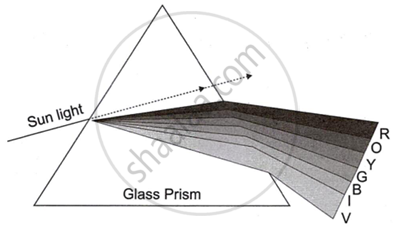
- Name the process shown in the figure.
- Name the colour that deviates the most.
- Name the colour that deviates the least.
- Name any one phenomenon in nature which is based on the above process.
- Define ‘spectrum’.
