Advertisements
Advertisements
Question
Study the following diagrams in which the path of a ray of light passing through a glass prism as traced by four students P, Q, R and S is shown:

The student who has traced the path correctly is
(A) P
(B) Q
(C) R
(D) S
Advertisements
Solution
Student Q has traced the path correctly.

When light is travelling from a rarer medium to a denser medium, it bends towards the normal to the surface, while the light from a denser medium to a rarer medium bends away from the normal to the surface.
Hence, the correct option is B.
APPEARS IN
RELATED QUESTIONS
Study the following figure in which a student has marked the angle of incidence (∠i), angle of refraction (∠r), angle of emergence (∠e), angle of prism (∠A) and the angle of deviation (∠D). The correctly marked angles are
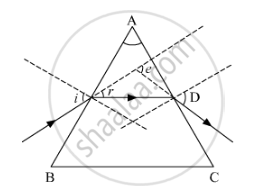
(a) ∠A and ∠i
(b) ∠A, ∠i and ∠r
(c) ∠A, ∠i, ∠e and ∠D
(d) ∠A, ∠i, ∠r and ∠D
Why do the component colours of incident white light split into a spectrum while passing through a glass prism, explain
As light rays emerge from a glass prism into air, are they refracted towards or away from the normal?
In the formation of spectrum of white light by a prism:
which colour is deviated most?
How does the speed of light determine the optical density of a medium?
When we place a glass prism in the path of a narrow beam of white light a spectrum is obtained. What happens when a second identical prism is placed in an inverted position with respect to the first prism? Draw a labelled ray diagram to illustrate it.
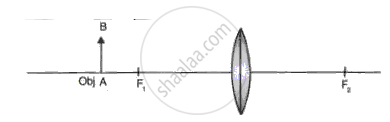
An object AB is placed in front of a convex lens as shown in fig. 4. Complete the ray diagram and obtain the image formed and state the nature of the image.
State two uses of ultraviolet radiation.
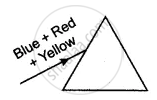
In the figure, a beam of light consisting of three colours blue, red, and yellow is incident on a prism and on a rectangular glass block respectively. Complete the diagram by drawings of the refracted and emergent rays.
Draw a neat and labelled diagram for dispersion of light.
