Advertisements
Advertisements
Question
Draw a neat and labelled diagram for dispersion of light.
Advertisements
Solution

APPEARS IN
RELATED QUESTIONS
Describe an activity to show that colours of white light splitted by a glass prism can be recombined to get white light by another identical glass prism. Also draw ray diagram to show the recombination of the spectrum of white light.
Draw a ray diagram to show the dispersion of white light.
What will happen if another similar glass prism is placed upside down behind the first prism?
Describe how you could demonstrate that white light is composed of a number of colours.
How could you show that the colours of the spectrum combine to give white light?
The coloured light having the maximum speed in glass prism is ______.
In figure AO is the ray of white light falling on a prism PQR. Complete the diagram till the light emerges out from the prism and falls on the screen.
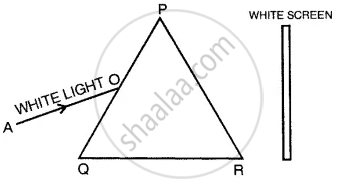
Define the term dispersion of light.
What do you understand by the term spectrum?
In an experiment to trace the path of a ray of light through a glass prism for different values of angle of incidence a student would find that the emergent ray:
(A) is parallel to the incident ray
(B) perpendicular to the incident ray
(C) is parallel to the refracted ray
(D) bends at an angle to the direction of incident ray
Differentiate between a glass slab and a glass prism.
Distinguish between an impure spectrum and a pure spectrum.
Write the range of wavelength of the ultraviolet spectrum.
Suggest one way, in each case, by which we can detect the presence of Infrared radiations.
Observe the given figure and answer the following questions.
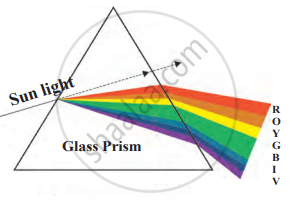
- Which colour light rays bend most?
- Which colour light rays bend least.
- What is the wavelength of violet light rays?
Why do we see a rainbow in the sky only after rainfall?
Assertion: We can see the rainbow in the sky when the rain starts falling after a spell of bright sunlight.
Reason: The rainbow is formed due to the dispersion of light.
A prism of refractive index `sqrt2` and refracting angle A produces minimum deviation δm of a ray on one face at an angle of incidence 45°, The values of A and δm are, respectively ______.
In the following diagram showing dispersion of white light by a glass prism, the colours 'P' and 'Q’ respectively are:

