Advertisements
Advertisements
प्रश्न
Draw a neat and labelled diagram for dispersion of light.
Advertisements
उत्तर

APPEARS IN
संबंधित प्रश्न
A narrow beam PQ of white light is passing through a glass prism ABC as shown in the diagram.

Trace it on your answer sheet and show the path of the emergent beam as observed on the screen DE.
(i) Write the name and cause of the phenomenon observed.
(ii) Where else in nature is this phenomenon observed?
(iii) Based on this observation, state the conclusion which can be drawn about the constituents of white light.
The path of a ray of light passing through a glass prism is shown below:
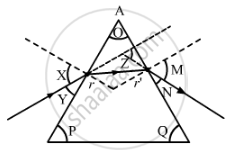
In this diagram, the angle of prism, angle of incidence, angle of emergence and angle of deviation, respectively, have been represented by:
(A) O, Y, Z and N,
(B) P, Y, M and Z,
(C) O, X, M and Z,
(D) P, X, Z and N.
In the figure given alongside, a narrow beam of white light is shown to pass through a triangular glass prism. After passing through the prism, it produces a spectrum YX on the screen.
Why do different colours of white light bend through different angles with respect to the incident beam of light?
Describe how you could demonstrate that white light is composed of a number of colours.
Which of the following colour of white light is least deviated by the prism?
(a) green
(b) violet
(c) indigo
(d) yellow
Why do you not see a spectrum of colours when light passes through a flat pane of glass?
While performing the experiment to trace the path of a ray of light passing through a glass prism, four students marked the incident ray and the emergent ray in their diagrams in the manner shown below. 
(A) I
(B) II
(C) III
(D) IV
Make the correct choice for each of the following:
Which one of the following Fig correctly shows the path of the ray through the glass block?
A wave has wavelength 50Å of name the wave.
Answer the following:
What do you mean by dispersion? Name the different colours of light in the proper sequence in the spectrum of light.
Differentiate between a glass slab and a glass prism.
What is the cause of the dispersion of white light through a glass prism? Draw a ray diagram to show the path of light when two identical glass prisms are arranged together in an inverted position with respect to each other and a narrow beam of white light is allowed to fall obliquely on one of the faces of the prisms.
What do you understand by spectrum? Name the seven prominent colours in order, as obtained in the spectrum of white light.
Write the range of wavelength of the ultraviolet spectrum.
Suggest one way, in each case, by which we can detect the presence of Infrared radiations.
Sunlight entering through a narrow aperture falls on a prism. Draw a neat labelled ray diagram to show the formation of the spectrum on a screen. Name the colour obtained nearer the base of the prism.
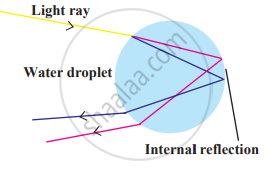
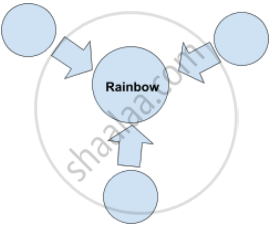
Rainbow is a beautiful natural phenomenon. It is the combined effect of a natural three processes together produced by light. Write it into the circle.