Advertisements
Advertisements
प्रश्न
Which of the following colour of white light is least deviated by the prism?
(a) green
(b) violet
(c) indigo
(d) yellow
Advertisements
उत्तर
Yellow
Yellow is the colour of white light that is the least deviated by a prism because it has the largest wavelength of the colours given in the alternatives.
APPEARS IN
संबंधित प्रश्न
Study the following diagrams in which the path of a ray of light passing through a glass prism as traced by four students P, Q, R and S is shown:

The student who has traced the path correctly is
(A) P
(B) Q
(C) R
(D) S
Draw a ray diagram to explain the term angle of deviation.
Define the term dispersion of white light.
Draw a diagram to show the refraction of light through a glass prism. On this diagram, mark
(i) incident ray
(ii) emergent ray, and
(iii) angle of deviation.
What is a rainbow?
The colour of white light which suffers the maximum bending (or maximum refraction) on passing through a glass prism is:
(a) yellow
(b) orange
(c) red
(d) violet
Out of the following, the colour of light having the maximum wavelength is:
(a) violet
(b) indigo
(c) green
(d) orange
Why do you not see a spectrum of colours when light passes through a flat pane of glass?
The seven colours in the spectrum of sunlight in order, are represented as :
- A beam of monochromatic light undergoes minimum deviation through an equiangular prism, how does the beam pass through the prism, with respect to its base?
- If white light is used in the same way as in part (a) above, what change do you expect in the emergent beam?
- What conclusion do you draw about the nature of white light in part (b)?
Complete the ray diagram given below to show the nature of light produced on the screen.
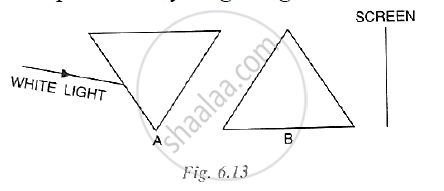
When we place a glass prism in the path of a narrow beam of white light a spectrum is obtained. What happens when a second identical prism is placed in an inverted position with respect to the first prism? Draw a labelled ray diagram to illustrate it.
A wave has wavelength 50Å of State its one use.
State two uses of ultraviolet radiation.
Distinguish between an impure spectrum and a pure spectrum.
Write the range of wavelength of the ultraviolet spectrum.
Suggest one way, in each case, by which we can detect the presence of Infrared radiations.
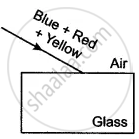
In the figure, a beam of light consisting of three colours blue, red, and yellow is incident on a prism and on a rectangular glass block respectively. Complete the diagram by drawings of the refracted and emergent rays.
Observe the given figure and answer the following questions.
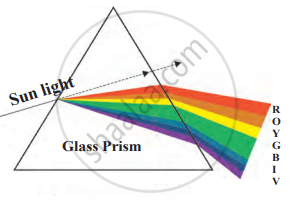
- Which colour light rays bend most?
- Which colour light rays bend least.
- What is the wavelength of violet light rays?
