Advertisements
Advertisements
प्रश्न
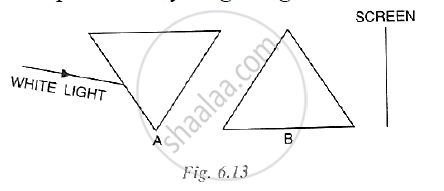
Complete the ray diagram given below to show the nature of light produced on the screen.
Advertisements
उत्तर
i. `4000^0A to 8000^0A`
ii. 400 nm to 800 nm
APPEARS IN
संबंधित प्रश्न
Study the following figure in which a student has marked the angle of incidence (∠i), angle of refraction (∠r), angle of emergence (∠e), angle of prism (∠A) and the angle of deviation (∠D). The correctly marked angles are
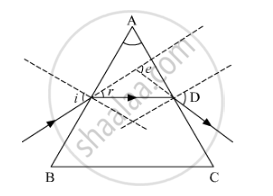
(a) ∠A and ∠i
(b) ∠A, ∠i and ∠r
(c) ∠A, ∠i, ∠e and ∠D
(d) ∠A, ∠i, ∠r and ∠D
- A ray of white light breaks up into its components while passing through a glass prism. Draw a ray diagram to show the path of rays.
- Mark the least deviated colour in your diagram.
- Why do different coloured rays deviate differently in a prism?
The colour of white light which suffers the maximum bending (or maximum refraction) on passing through a glass prism is:
(a) yellow
(b) orange
(c) red
(d) violet
The coloured light having the maximum speed in glass prism is ______.
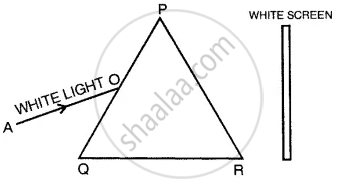
In figure AO is the ray of white light falling on a prism PQR. Complete the diagram till the light emerges out from the prism and falls on the screen.
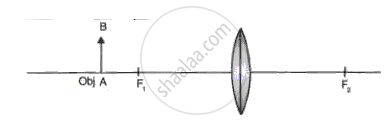
An object AB is placed in front of a convex lens as shown in fig. 4. Complete the ray diagram and obtain the image formed and state the nature of the image.
A wave has wavelength 50Å of name the wave.
Distinguish between an impure spectrum and a pure spectrum.
Suggest one way, in each case, by which we can detect the presence of Infrared radiations.
The angle of deviation through a prism is minimum when

- Incident rays and emergent rays are symmetric to the prism.
- The refracted ray inside the prism becomes parallel to its base.
- The angle of incidence is equal to that of the angle of emergence.
- When the angle of emergence has doubled the angle of incidence.
Choose the correct answer from the options given below:
