Advertisements
Advertisements
प्रश्न
- A ray of white light breaks up into its components while passing through a glass prism. Draw a ray diagram to show the path of rays.
- Mark the least deviated colour in your diagram.
- Why do different coloured rays deviate differently in a prism?
Advertisements
उत्तर
- The splitting of white light into its component colours on passing through a glass prism is shown in the following diagram.

- The least deviated colour is red, which is marked in the diagram.
- Different colours have different wavelengths; therefore, they deviate differently when passing through a glass prism. The amount of deviation depends on the wavelength of the coloured light.
संबंधित प्रश्न
A student traces the path of a ray of light through a triangular glass prism for different values of angle of incidence. On analyzing the ray diagrams, which one of the following conclusions is he likely to draw?
(A) The emergent ray is parallel to the incident ray.
(B) The emergent ray bends at an angle to the direction of the incident ray.
(C) The emergent ray and the refracted ray are at right angles to each other.
(D) The emergent ray is perpendicular to the incident ray.
State the cause of dispersion of white light passing through a glass prism. How did Newton show that white light of sun contains seven colours using two identical glass prisms. Draw a ray diagram to show the path of light when two identical glass prisms are arranged together in inverted position with respect to each other and a narrow beam of white light is allowed to fall obliquely on one of the focus of the first prism.
Draw a ray diagram to explain the term angle of deviation.
In the formation of spectrum of white light by a prism:
which colour is deviated most?
Out of the following, the colour of light having the maximum wavelength is:
(a) violet
(b) indigo
(c) green
(d) orange
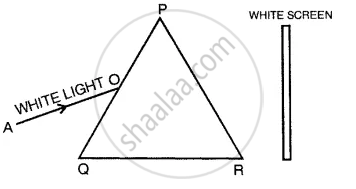
In figure AO is the ray of white light falling on a prism PQR. Complete the diagram till the light emerges out from the prism and falls on the screen.
Explain the cause of dispersion of white light through a prism.
The diagram below shows the path taken by a narrow beam of yellow monochromatic light passing through an equiangular glass prism. If the yellow light is replaced by a narrow beam of white light incident at the same angle, draw another diagram to show the passage of white light through the prism and label it to show the effect of prism on the white light.

In the spectrum of white light by a prism, the colour at the extreme end opposite to the base of prism is ______.
While performing the experiment to trace the path of a ray of light passing through a glass prism, four students marked the incident ray and the emergent ray in their diagrams in the manner shown below. 
(A) I
(B) II
(C) III
(D) IV
The wavelength range of white light is ______.
What is the cause of the dispersion of white light through a glass prism? Draw a ray diagram to show the path of light when two identical glass prisms are arranged together in an inverted position with respect to each other and a narrow beam of white light is allowed to fall obliquely on one of the faces of the prisms.
Which characteristic property of light is responsible for the blue colour of the sky?
Write the range of wavelength of the ultraviolet spectrum.
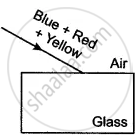
In the figure, a beam of light consisting of three colours blue, red, and yellow is incident on a prism and on a rectangular glass block respectively. Complete the diagram by drawings of the refracted and emergent rays.
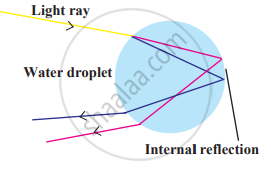
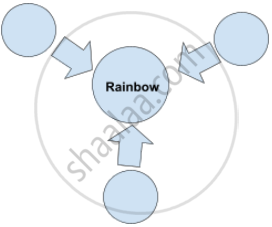
Rainbow is a beautiful natural phenomenon. It is the combined effect of a natural three processes together produced by light. Write it into the circle.
When white light enters a glass prism from the air, the angle of deviation is least for ____________.
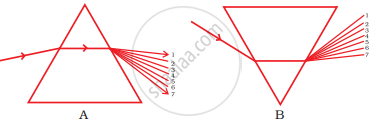
State the correct sequence (1-7) of colours in the spectrum formed by the prisms A and B, shown in the following figure.
What is a rainbow?
