Advertisements
Advertisements
प्रश्न
In the spectrum of white light by a prism, the colour at the extreme end opposite to the base of prism is ______.
पर्याय
Violet
Yellow
Red
Blue
Advertisements
उत्तर
In the spectrum of white light by a prism, the colour at the extreme end opposite to the base of prism is red.
APPEARS IN
संबंधित प्रश्न
In the figure given alongside, a narrow beam of white light is shown to pass through a triangular glass prism. After passing through the prism, it produces a spectrum YX on the screen.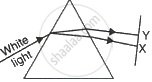
- State the colour seen
- at X, and
- at Y.
- Why do different colours of white light bend through different angles with respect to the incident beam of light?
Which of the following colour of white light is least deviated by the prism?
(a) green
(b) violet
(c) indigo
(d) yellow
Which is optically denser: water or air? Give reason
The frequency range of visible light is from 3.75 × 10¹⁴ Hz to 7.5 × 10¹⁴ Hz. Calculate its wavelength range. Take speed of light = 3 × 10⁸ m/s.
An object AB is placed in front of a convex lens as shown in fig. 4. Complete the ray diagram and obtain the image formed and state the nature of the image.
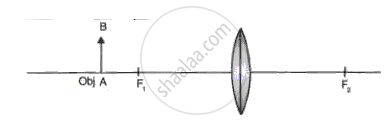
Write an Explanation.
Critical angle
Say TRUE or FALSE
After passing through a prism, white light splits into a band of seven colours
Which one of the following is involved for the formation of rainbow in the sky?
During dispersion of white light by prism placed in air, for a particular value of angle of prism,
A ray of light is incident at 45° on an equilateral prism in the diagram below.

- Name the phenomenon exhibited by the ray of light when it enters and emerges out of the prism.
- State the cause of the above phenomenon mentioned by you.
