Advertisements
Advertisements
प्रश्न
Write an Explanation.
Critical angle
Advertisements
उत्तर
For a particular value of i (angle of incidence) for which, the value of r (angle of refraction) becomes equal to 90°, is called the critical angle.
APPEARS IN
संबंधित प्रश्न
In the following diagram, the path of a ray of light passing through a glass prism is shown:
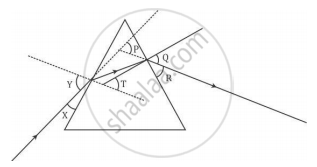
In this diagram the angle of incidence, the angle of emergence and the angle of deviation respectively are (select the correct option):
(A) X, R and T
(B) Y, Q and T
(C) X, Q and P
(D) Y, Q and P
State the cause of dispersion of white light passing through a glass prism. How did Newton show that white light of sun contains seven colours using two identical glass prisms. Draw a ray diagram to show the path of light when two identical glass prisms are arranged together in inverted position with respect to each other and a narrow beam of white light is allowed to fall obliquely on one of the focus of the first prism.
Why do the component colours of incident white light split into a spectrum while passing through a glass prism, explain
What is spectrum?
In the figure given alongside, a narrow beam of white light is shown to pass through a triangular glass prism. After passing through the prism, it produces a spectrum YX on the screen.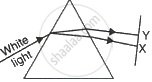
- State the colour seen
- at X, and
- at Y.
- Why do different colours of white light bend through different angles with respect to the incident beam of light?
A beam of white light is shone onto a glass prism. The light cannot be:
(a) deviated
(b) dispersed
(c) focused
(d) refracted
The colour of white light which is deviated the maximum on passing through the glass prism is:
(a) blue
(b) indigo
(c) red
(d) orange
The seven colours in the spectrum of sunlight in order, are represented as :
State the speed of light in (a) air, (b) water, and (c) glass
The diagram below shows the path taken by a narrow beam of yellow monochromatic light passing through an equiangular glass prism. If the yellow light is replaced by a narrow beam of white light incident at the same angle, draw another diagram to show the passage of white light through the prism and label it to show the effect of prism on the white light.

In the spectrum of white light by a prism, the colour at the extreme end opposite to the base of prism is ______.
In an experiment to trace the path of a ray of light through a glass prism for different values of angle of incidence a student would find that the emergent ray:
(A) is parallel to the incident ray
(B) perpendicular to the incident ray
(C) is parallel to the refracted ray
(D) bends at an angle to the direction of incident ray
A glass prism is able to produce the spectrum when white light passes through it, but a glass slab doesn’t produce any spectrum. Explain why it is so.
Which characteristic property of light is responsible for the blue colour of the sky?
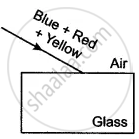
In the figure, a beam of light consisting of three colours blue, red, and yellow is incident on a prism and on a rectangular glass block respectively. Complete the diagram by drawings of the refracted and emergent rays.
Match the Columns:
| Column ‘A’ | Column ‘B’ |
| The wavelength of red light | (a) 600 nm |
| (b) 700 nm | |
| (c) 500 nm |
When white light enters a glass prism from the air, the angle of deviation is least for ____________.
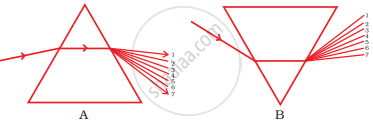
State the correct sequence (1-7) of colours in the spectrum formed by the prisms A and B, shown in the following figure.
Which one of the following is involved for the formation of rainbow in the sky?
In dispersion, the color of light that will bend more is ______.
