मराठी
सी.आई.एस.सी.ई.आयसीएसई ICSE Class 8

State the speed of light in (a) air, (b) water, and (c) glass - Physics

Advertisements
Advertisements

प्रश्न

State the speed of light in (a) air, (b) water, and (c) glass

थोडक्यात उत्तर
Advertisements

उत्तर

Speed of light in
Air - 3 × 10⁸ ms-1  or 300000 km/h
Water - 2.25 × 10⁸ ms-1
Glass - 2 × 10⁸  ms-1

shaalaa.com
  या प्रश्नात किंवा उत्तरात काही त्रुटी आहे का?
पाठ 5: Light Energy - Short/long Answer Question [पृष्ठ ९९]

APPEARS IN

सेलिना Concise Physics [English] Class 8 ICSE
पाठ 5 Light Energy
Short/long Answer Question | Q 1 | पृष्ठ ९९

संबंधित प्रश्‍न

In the following diagram, the path of a ray of light passing through a glass prism is shown:

In this diagram the angle of incidence, the angle of emergence and the angle of deviation respectively are (select the correct option):

(A) X, R and T

(B) Y, Q and T

(C) X, Q and P

(D) Y, Q and P


Study the following figure in which a student has marked the angle of incidence (∠i), angle of refraction (∠r), angle of emergence (∠e), angle of prism (∠A) and the angle of deviation (∠D). The correctly marked angles are

(a) ∠A and ∠i

(b) ∠A, ∠i and ∠r

(c) ∠A, ∠i, ∠e and ∠D

(d) ∠A, ∠i, ∠r and ∠D


The path of a ray of light passing through a glass prism is shown below:

In this diagram, the angle of prism, angle of incidence, angle of emergence and angle of deviation, respectively, have been represented by:

(A) O, Y, Z and N,

(B) P, Y, M and Z,

(C) O, X, M and Z,

(D) P, X, Z and N.


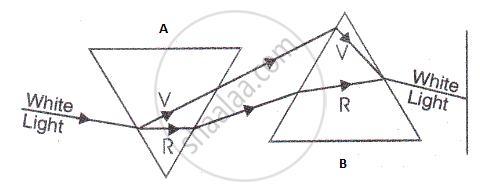
 What will happen if another similar glass prism is placed upside down behind the first prism?


Why do you not see a spectrum of colours when light passes through a flat pane of glass?


The seven colours in the spectrum of sunlight in order, are represented as :


When a white light ray falls on a prism, the ray at its first surface suffers ______.


In an experiment to trace the path of a ray of light through a triangular glass prism, a student would observe that the emergent ray

(a) is parallel to the incident ray.

(b) is along the same direction of incident ray.

(c) gets deviated and bends towards the thinner part of the prism.

(d) gets deviated and bends towards the thicker part (base) of the prism.


In an experiment to trace the path of a ray of light through a glass prism for different values of angle of incidence a student would find that the emergent ray: 

(A) is parallel to the incident ray

(B) perpendicular to the incident ray

(C) is parallel to the refracted ray

(D) bends at an angle to the direction of incident ray


In the figure, a beam of light consisting of three colours blue, red, and yellow is incident on a prism and on a rectangular glass block respectively. Complete the diagram by drawings of the refracted and emergent rays.


Share
Notifications

Englishहिंदीमराठी


      Forgot password?
Use app×